
Key Takeaways
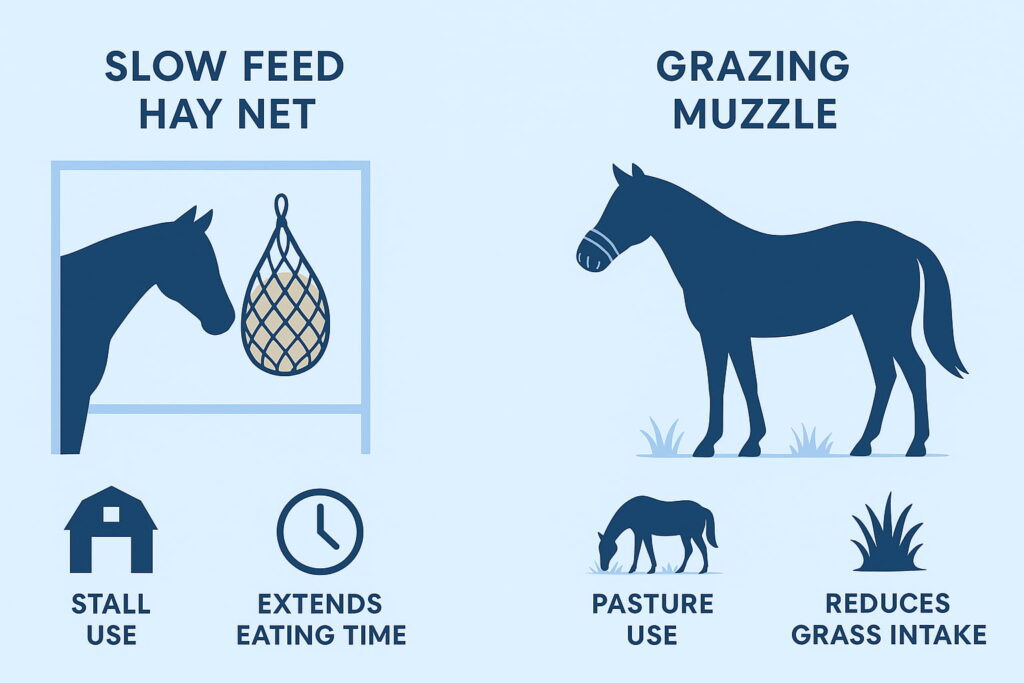
- Slow feed hay nets extend eating time for stalled horses by 60-200%, helping prevent gastric ulcers and supporting natural foraging behavior while managing weight through controlled hay consumption.[1]
- Grazing muzzles reduce grass intake by 30-80% on pasture, making them highly effective for weight loss in metabolic horses when worn for extended periods (10-24 hours daily).[2][3]
- Choose the right tool for your forage type: hay nets work best for managing hay in stalls or dry lots, while grazing muzzles are designed specifically for pasture grass control—using the wrong tool for the wrong forage leads to frustration and poor results.
- Both methods support gut health by extending foraging time, which keeps stomach acid buffered and reduces the risk of colic and behavioral issues associated with meal feeding.[1][4]
- Success depends on proper use: hay nets need appropriate hole sizing for your horse’s body condition, while muzzles require gradual introduction, proper fit, and must allow water drinking at all times.
When managing weight in horses with metabolic issues, slow feed hay nets and grazing muzzles serve different but complementary purposes—hay nets control the speed of hay consumption in confined spaces, while grazing muzzles restrict grass intake on pasture. Your choice depends entirely on where your horse eats and what type of forage they’re consuming.
Understanding Slow Feed Hay Nets
Slow feed hay nets are mesh bags with varying hole sizes that hold hay and force horses to pull small amounts through the openings. This simple tool transforms how quickly your horse eats their allocated hay ration.
How Hay Nets Slow Down Eating
Research from the University of Minnesota shows that horses eating from slow feed hay nets with small openings (3.2 cm) take 6.5 hours to finish a meal that would normally be consumed in just 3.1 hours when fed on the stall floor.[1] Medium-sized openings (4.4 cm) extended eating time to 5.1 hours. This dramatic increase in foraging time more closely mimics a horse’s natural grazing pattern.
The nets work by creating a physical barrier that prevents horses from taking large bites. Instead, they must carefully work their lips and teeth to extract hay through the mesh openings. This process not only extends meal duration but also keeps horses mentally engaged in foraging behavior throughout the day.
Weight Management Benefits of Hay Nets
A controlled study examining limit-fed diets combined with slow feed hay nets found that overweight horses successfully lost weight over a 28-day period when hay was restricted to 1% of body weight daily.[5] Horses fed from hay nets showed lower peak insulin and cortisol levels compared to horses eating the same amount of hay off the stall floor. The slower eating rate helped maintain more stable blood glucose and hormone patterns—critical factors for horses with insulin resistance or equine metabolic syndrome.
For easy keepers and metabolically challenged horses, hay nets provide a practical solution to a common problem: how do you feed less hay without leaving your horse standing idle with an empty stomach for hours? The extended eating time means your horse spends more time engaged in natural behavior even when consuming a reduced ration.
Choosing the Right Net Size
Hay net hole sizes range from 1.25 inches to over 6 inches. Your horse’s body condition and temperament should guide your choice. Small-holed nets (1.25-2 inches) work best for overweight horses or those prone to rapid hay consumption. These nets create the longest eating times but may frustrate horses unaccustomed to working for their food.
Medium-holed nets (2-3 inches) offer a balance between slowing intake and maintaining accessibility. They work well for horses at a moderate body condition score who need some intake regulation without extreme restriction. Large-holed nets (4-6 inches) primarily reduce hay waste rather than significantly slowing consumption, making them better suited for horses at ideal weight.
Proper Hay Net Placement
Where you hang your hay net matters significantly for your horse’s respiratory and musculoskeletal health. Hang nets low enough that horses eat with their heads in a natural grazing position—at or below shoulder height.[6] Elevated nets force horses to eat with their heads up, which prevents proper nasal drainage and increases the risk of respiratory irritants entering the airways.
For ground-level feeding, secure nets in a tub or box to prevent them from shifting while your horse eats. This setup mimics natural grazing position most closely and is particularly beneficial for horses with respiratory sensitivities or those prone to dust allergies.
Understanding Grazing Muzzles
Grazing muzzles are basket-style devices that fit over a horse’s muzzle with a small opening at the bottom. They attach to a halter and allow horses to remain on pasture while dramatically limiting grass consumption.
How Muzzles Reduce Grass Intake
Grazing muzzles work by restricting bite size rather than completely preventing eating. The small opening at the bottom of the basket allows only the tips of grass blades to poke through, forcing horses to take much smaller bites than they would naturally.
Multiple research studies confirm that grazing muzzles reduce dry matter intake by 30-80% depending on grass length, muzzle design, and duration of use.[2][3][7] A University of Minnesota study found a consistent 30% reduction in forage intake regardless of grass species when horses were muzzled.[8] UK research on ponies grazing for three-hour periods showed intake reductions of 75-88% when muzzled.[9]
Timing and Duration for Weight Loss
How long should horses wear grazing muzzles? Research provides clear guidance: part-time muzzling often fails because horses compensate by eating more rapidly when unmuzzled.[10] Studies on miniature horses found that muzzling for 24 hours daily was necessary to achieve actual weight loss, while horses muzzled for only 10 hours per day still gained weight due to compensatory grazing during unmuzzled hours.[3][10]
The only treatment group that lost weight in the Maryland study wore muzzles continuously throughout their 23-hour daily pasture turnout period.[10] Horses muzzled for 10 hours or left unmuzzled both gained weight. This finding challenges the common practice of part-time muzzling and highlights the importance of consistent use for horses requiring weight loss.
Behavioral Impact and Welfare
Many owners worry that grazing muzzles cause stress or frustration. Research examining behavior and physiological stress markers provides reassuring results. Studies measuring salivary cortisol, heart rate variability, and behavioral observations found that properly fitted muzzles did not increase stress indicators in horses, even when worn continuously.[3][10]
Horses did show altered time budgets—spending more time engaged in foraging behavior and less time in other activities—but this reflects the increased effort required to eat through the muzzle rather than psychological distress. The acceptance score did decline slightly by the third week of use, suggesting horses don’t particularly enjoy muzzles, but stress hormones remained normal.
Grass Length and Muzzle Effectiveness
Grass length significantly affects how well muzzles work. Research from the WALTHAM Equine Studies Group found that ponies showed more frustration-related behaviors when grazing muzzled on longer grass swards.[11] Shorter grass (less than 4 inches) allows muzzled horses to graze more easily and with less frustration.
If your pasture has tall, mature grass, consider mowing it shorter before introducing a grazing muzzle. This simple management change can make the difference between a horse that accepts the muzzle calmly and one that shows signs of distress.
| Management Tool | Best Used For | Intake Reduction | Primary Location | Key Advantage |
|---|---|---|---|---|
| Slow Feed Hay Net | Controlling hay consumption rate | Extends eating time 60-200%[1] | Stalls, dry lots, paddocks | Reduces hay waste while supporting gut health |
| Grazing Muzzle | Restricting pasture grass intake | Reduces intake 30-80%[2][3] | Grass pastures | Allows natural grazing behavior with controlled intake |
| Ground Feeding (control) | Horses at ideal weight | No reduction | Any location | Natural head position, minimal equipment |
Choosing Between Hay Nets and Grazing Muzzles
Your forage type and turnout situation determine which tool will work best for your metabolic horse.
When to Use Slow Feed Hay Nets
Choose hay nets when your horse primarily eats hay in confined spaces. This includes horses that spend significant time in stalls, small paddocks, or dry lots without grass access. Hay nets excel at managing hay consumption from flakes, small bales, or round bales in these settings.
Hay nets work particularly well for horses that need low-sugar feeds because they can extend eating time for soaked or rinsed hay. Since soaking reduces water-soluble carbohydrates that trigger metabolic issues, combining soaked hay with slow feed nets gives you excellent control over both sugar intake and eating speed.
Dr. Krishona Martinson, Extension Equine Specialist at the University of Minnesota, notes that “using small or medium hay nets to feed in a box stall setting twice daily would allow horses to forage for 10 to 13 hours daily” compared to just a few hours when hay is fed on the ground.[12]
When to Use Grazing Muzzles
Grazing muzzles are the clear choice for horses living on grass pasture who need weight management. If your horse has 24-hour pasture access or spends most of their time on grass, a muzzle provides intake control while allowing them to remain with their herd.
Muzzles are essential for horses showing signs of metabolic stress who must stay on pasture due to space limitations or behavioral needs. They prevent the rapid grass consumption that leads to dangerous insulin spikes in horses with equine metabolic syndrome or insulin resistance.
However, grazing muzzles do not work for hay feeding. Horses cannot effectively eat hay through a grazing muzzle, especially long-stem hay or hay from round bales. The muzzle basket prevents them from obtaining adequate amounts of hay, leading to frustration and inadequate forage intake.
Using Both Tools Together
Many metabolic horses benefit from using both slow feed hay nets and grazing muzzles in combination. Use hay nets when feeding hay during stall time or overnight confinement. Switch to a grazing muzzle during turnout on grass pasture. This approach gives you comprehensive control over forage intake around the clock.
For horses transitioning between seasonal grass and hay-only feeding, having both tools available ensures consistent weight management regardless of forage type. In spring when grass grows rapidly, muzzles prevent gorging on lush pasture. In winter when hay becomes the primary forage, hay nets extend eating time and prevent waste.
Common Mistakes to Avoid
Hanging Hay Nets Too High
One of the most common errors is hanging hay nets at eye level or higher. This unnatural head position causes multiple problems. It forces horses to eat with their heads elevated, which prevents proper drainage from nasal passages and increases respiratory irritation when hay is dusty.[6] The awkward posture can also contribute to poll and neck soreness over time.
Instead, hang nets at or below shoulder height. Even better, place hay nets at ground level in a secure container. This mimics natural grazing position and supports optimal respiratory health.
Choosing Wrong Net Size for Horse Type
Using extremely small-holed nets (under 1.5 inches) on hard keepers or underweight horses can backfire. These horses may become discouraged and eat less than they need, leading to weight loss when weight gain is desired. One study participant noted that switching her hard keeper from slow feed nets to ground feeding actually helped the horse maintain weight better.[13]
Conversely, using large-holed nets on overweight horses provides minimal benefit. The hay consumption rate barely changes, defeating the purpose of using a slow feeder in the first place.
Part-Time Muzzling for Weight Loss
The research is clear: horses compensate for restricted grazing time by eating more rapidly when unmuzzled. Part-time muzzling typically fails to produce weight loss because horses simply eat faster during unmuzzled hours to make up for lost intake.[10] If your goal is actual weight reduction rather than just slowing weight gain, commit to extended or continuous muzzle use during all pasture time.
Poor Muzzle Fit
An ill-fitting grazing muzzle causes rubbing, prevents drinking, or allows too much grass access. The muzzle should sit comfortably on the horse’s face without rubbing the bridge of the nose or restricting jaw movement. Check that your horse can drink water easily through the muzzle—this is non-negotiable for safe use.[14]
Introduce muzzles gradually over several days, starting with short wearing periods while supervised. This acclimation period helps horses learn to graze effectively through the small opening and prevents initial frustration.
Comparing Hay Nets vs Grazing Muzzles
| Feature | Slow Feed Hay Nets | Grazing Muzzles |
|---|---|---|
| Primary Purpose | Extend hay eating time in confined spaces | Restrict grass intake on pasture |
| Intake Reduction | Slows consumption rate (doubles to triples eating time)[1] | Reduces total intake 30-80%[2][3] |
| Best For | Stalled horses, dry lot feeding, hay management | Pasture turnout, grass grazing control |
| Forage Type | Hay (flakes, small bales, round bales) | Short grass only (not effective for hay) |
| Time Requirement | Fill 1-2 times daily depending on net size | Must check fit and allow drinking multiple times daily |
| Cost Range | $20-$80 depending on size and quality | $30-$100 depending on brand and features |
| Safety Considerations | Can entangle shod horses if hung too low; requires secure hanging | Must allow water access; requires proper fit to prevent rubbing |
| Behavioral Impact | Increases foraging time; may frustrate initially | Alters time budget but doesn’t increase stress[10] |
| Maintenance | Wash regularly to prevent mold; check for damage | Clean daily; check straps and attachments for wear |
Supporting Overall Metabolic Health
Integrating Slow Feeding with Diet Management
Neither hay nets nor grazing muzzles work in isolation. They’re tools that support a comprehensive weight management plan for metabolic horses. Your horse still needs balanced nutrition with appropriate vitamins, minerals, and protein even when calories are restricted.
Test your hay for sugar and starch content, especially if feeding horses with insulin resistance. Even when fed through a slow feed net, high-NSC hay can trigger metabolic problems. Soaking hay for 30-60 minutes before placing it in the net reduces water-soluble carbohydrates by 30-50%, providing additional protection for at-risk horses.
Exercise and Movement
Both hay nets and grazing muzzles extend foraging time, which naturally increases movement as horses work to obtain their food. However, they don’t replace the need for structured exercise. Horses requiring weight loss benefit from a combination of controlled forage intake and regular exercise appropriate for their fitness level and any soundness limitations.
Grazing muzzles have an advantage here—muzzled horses on pasture cover more ground while foraging compared to horses eating hay from a stationary net in a small pen. This increased movement contributes to calorie expenditure and cardiovascular health.
Monitoring Progress
Regular body condition scoring and weight monitoring tell you whether your chosen strategy is working. Weigh or weight tape your horse at least monthly, and adjust forage management as needed based on results. Some horses lose weight readily with hay nets alone; others require grazing muzzles plus exercise plus diet changes to show improvement.
Track not just weight but also metabolic markers if your horse has insulin resistance or equine metabolic syndrome. Work with your veterinarian to monitor ACTH levels, insulin response, and glucose tolerance. These objective measures confirm whether your forage management strategy is supporting metabolic health.
Expert Perspective on Forage Management
“Modern horse management systems tend to limit a horse’s opportunity to forage. The use of slow-feed hay nets represents an opportunity to extend foraging time while feeding a restricted diet. When combined with limit feeding, slow-feed hay nets appear to be an effective method for decreasing body weight and maintaining more homeostatic levels of postprandial metabolites and hormones when feeding overweight adult horses.”[5]— Research published in Journal of Animal Science
Real-World Application
Case Study: Managing a Metabolic Mare
A 15-year-old Quarter Horse mare with equine metabolic syndrome presented with a body condition score of 8/9 and recurring mild laminitis. The owner implemented a combined approach: slow feed hay nets with 2-inch holes for overnight stall time (6 PM to 8 AM) and a grazing muzzle during daytime pasture turnout (8 AM to 6 PM).[15]
After 12 weeks, the mare’s body condition score dropped to 6/9, representing a 150-pound weight loss. More importantly, her insulin levels decreased from 45 μIU/mL to 18 μIU/mL, moving her out of the danger zone for metabolic complications. The combination of both tools allowed the mare to maintain natural behaviors and herd interaction while achieving necessary weight loss.
Case Study: Pony Club Member’s Easy Keeper
A 12-year-old Welsh pony maintained on a small property gained excessive weight during spring grass growth. The owner introduced a grazing muzzle for all pasture time (approximately 20 hours daily) and used a small-holed hay net for supplemental hay during barn time.[16]
Initial acceptance was challenging—the pony showed frustration behaviors for the first three days. However, after a week of consistent use with gradual acclimation, the pony settled into the routine. Over a 16-week period through summer, the pony maintained stable weight despite lush pasture, preventing the seasonal obesity pattern that had occurred in previous years.
Conclusion
Slow feed hay nets and grazing muzzles are proven tools for managing weight in metabolic horses, but they’re not interchangeable. Hay nets excel at extending the eating time for hay-fed horses in stalls, paddocks, and dry lots, reducing the risk of gastric ulcers while controlling consumption rate. Grazing muzzles provide essential grass intake restriction for horses living on pasture, with research confirming 30-80% reductions in forage consumption when used consistently.
Your success depends on matching the right tool to your horse’s forage type and living situation. Use hay nets for hay, muzzles for grass, and both together if your horse transitions between hay feeding and pasture grazing. Remember that these tools support—but don’t replace—a complete metabolic management program including appropriate diet, regular exercise, and veterinary monitoring. Take control of your horse’s forage intake today by implementing the tool that matches your management situation.
Slow Feed Hay Nets vs Grazing Muzzles FAQs
Can I use a grazing muzzle when feeding hay?
Grazing muzzles are not designed for hay feeding and don’t work effectively with hay, particularly long-stem hay or hay from round bales. The basket design prevents horses from obtaining adequate amounts of hay, causing frustration and insufficient forage intake. For hay management, use slow feed hay nets instead of grazing muzzles.[17]
How long should I leave a grazing muzzle on my horse?
Research shows that grazing muzzles should remain on for extended periods to prevent weight gain—ideally during all pasture access time. Studies found that horses muzzled for only 10 hours per day still gained weight due to compensatory grazing when unmuzzled, while horses muzzled for 24 hours achieved actual weight loss. For weight maintenance rather than loss, 10-12 hours daily may suffice.[10][3]
Do slow feed hay nets cause dental problems?
A year-long research study examining the dental effects of slow feed hay nets found no negative impact on incisor length or increased dental abnormalities compared to ground feeding. Horses eating from hay nets showed the same dental health as horses fed hay without nets, dispelling concerns about excessive tooth wear from net use.[18]
What size holes should I choose for my slow feed hay net?
Choose hole size based on your horse’s body condition and eating speed. Small holes (1.25-2 inches) work best for overweight horses or fast eaters, extending eating time to 6+ hours per meal. Medium holes (2-3 inches) suit horses at moderate body condition, providing a balance between slowing intake and accessibility. Large holes (4+ inches) primarily reduce waste rather than significantly slowing consumption.[1]
Will grazing muzzles stress my metabolic horse?
Research measuring physiological stress indicators including salivary cortisol and heart rate found that properly fitted grazing muzzles do not increase stress in horses, even when worn continuously. While horses may show altered behavior patterns (spending more time foraging), stress hormones remain within normal ranges, indicating that muzzles don’t cause psychological distress when introduced gradually and fitted correctly.[3][10]
Slow Feed Hay Nets vs Grazing Muzzles Citations
- Martinson, K., Glunk, E., & Weber, W. (2014). The Effect of Hay Net Design on Rate of Forage Consumption When Feeding Adult Horses. Journal of Equine Veterinary Science, 34(8), 986-991. https://www.sciencedirect.com/science/article/abs/pii/S0737080614001737
- Glunk, E. C., et al. (2014). The effect of a limit-fed diet and slow-feed hay nets on morphometric measurements and postprandial metabolite and hormone patterns in adult horses. Journal of Animal Science, 92(10), 4500-4509. https://pubmed.ncbi.nlm.nih.gov/26440194/
- Davis, K. M., et al. (2020). Effects of grazing muzzles on behavior and physiological stress of individually housed grazing miniature horses. Applied Animal Behaviour Science, 227, 104991. https://www.sciencedirect.com/science/article/abs/pii/S0168159120301556
- Martinson, K., & Hathaway, M. (2015). Horse weight loss: hay nets and limit-fed diets. University of Minnesota Extension. https://extension.umn.edu/horse-nutrition/horse-weight-loss
- Glunk, E. C., Hathaway, M. R., Weber, W. J., & Martinson, K. L. (2015). The effect of a limit-fed diet and slow-feed hay nets on morphometric measurements and postprandial metabolite and hormone patterns in adult horses. Journal of Animal Science, 93(10), 4500-4509.
- On Course Equine Nutrition. (2023). 6 Dangers of Slow Feeders. https://www.oncourseequinenutrition.com/post/6-dangers-of-slow-feeders
- Longland, A. C., Barfoot, C., & Harris, P. A. (2011). Effects of grazing muzzles on intakes of dry matter and water-soluble carbohydrates by ponies grazing spring, summer and autumn pastures.
- Martinson, K., & Hathaway, M. Using grazing muzzles to reduce forage intakes in horses. University of Minnesota Extension. https://extension.umn.edu/horse-nutrition/using-grazing-muzzles-reduce-forage-intakes-horses
- Mad Barn. (2025). Grazing Muzzles for Horses and Ponies. https://madbarn.com/grazing-muzzles-for-horses/
- Davis, K. M., et al. (2020). Effects of grazing muzzles on behavior, voluntary exercise, and physiological stress of miniature horses housed in a herd. Applied Animal Behaviour Science, 230, 105062. https://www.sciencedirect.com/science/article/abs/pii/S0168159120301969
- WALTHAM Equine Studies Group. Grass length can affect muzzled grazing behaviour in ponies. https://www.waltham.com/news-events/nutrition/grass-length-can-affect-muzzled-grazing-behaviour
- Martinson, K. Using slow feed hay nets. University of Minnesota Extension. https://extension.umn.edu/horse-nutrition/using-slow-feed-hay-nets
- The Horse Forum. Interesting Research on Haynets. https://www.horseforum.com/threads/interesting-research-on-haynets.835195/
- Shires Equestrian. How to Use a Grazing Muzzle. https://shiresequestrian.com/blogs/news/how-to-use-a-grazing-muzzle
- Boast, M. (2024). Grazing Muzzles and Weight Control. Horse Sport. https://horsesport.com/magazine/health/grazing-muzzles-weight-control/
- Longland, A. C., Barfoot, C., & Harris, P. A. (2016). Efficacy of wearing grazing muzzles for 10 hours per day on controlling bodyweight in pastured ponies. Journal of Equine Veterinary Science, 42, 36-42. https://www.sciencedirect.com/science/article/abs/pii/S073708061530085X
- Kentucky Equine Research. Answer: Using a Muzzle and Feeding Round Baled Hay. https://ker.com/equinews/answer/using-muzzle-and-feeding-round-baled-hay/
- Tribute Equine Nutrition. (2025). Hay Nets for Horses: Pros, Cons & Safety Tips. https://tributeequinenutrition.com/blogs/news/hay-nets-are-they-good-or-bad




Leave a Reply