
Key Takeaways
- Formula 707 maintains NASC certification through comprehensive independent audits conducted every two years, ensuring consistent quality standards across their Colorado manufacturing facility
- Supplement stability testing involves both accelerated protocols (exposing products to elevated temperature/humidity) and real-time studies to establish accurate shelf life predictions
- Quality manufacturers use ingredient overage—adding 10-20% extra vitamins like biotin and B6—to account for natural degradation over 12-24 month shelf lives
- Certificate of Analysis (COA) documents provide batch-specific verification that supplements meet label claims at time of testing, but don’t guarantee potency throughout shelf life
- Proper storage conditions (cool, dry, sealed containers away from sunlight) can extend supplement effectiveness beyond listed expiration dates, though potency gradually decreases after manufacturing
Formula 707 MetaStable Pellets contain leucine, vitamin B6, and resveratrol—ingredients validated by university research demonstrating efficacy for metabolic support in horses. But how do you know the supplement you’re feeding today contains the same potency as when it was manufactured months ago?
Understanding Stability Testing in Equine Supplements
Stability testing determines how a supplement’s quality changes over time under specific storage conditions. Unlike pharmaceuticals where stability directly impacts safety, supplement stability is primarily a quality concern—ensuring consumers receive products that meet labeled nutrient levels throughout the stated shelf life.[1]
The equine supplement industry relies on two primary testing approaches. Real-time stability studies track supplements stored under normal conditions over extended periods, providing the most accurate shelf life data but requiring months to years to complete. Accelerated stability testing exposes products to elevated temperatures (typically 40°C) and humidity (75% relative humidity) to simulate long-term storage in compressed timeframes.[2]
Most pelleted equine supplements are formulated for 12-24 month shelf lives when stored properly. Formula 707, created in 1960 by John Ewing Company (established 1946), manufactures all products in their dedicated Colorado facility in La Salle, where they have consistently maintained this industry standard through controlled production processes and quality oversight.[3]
The NASC Quality Seal: Third-Party Verification Standards
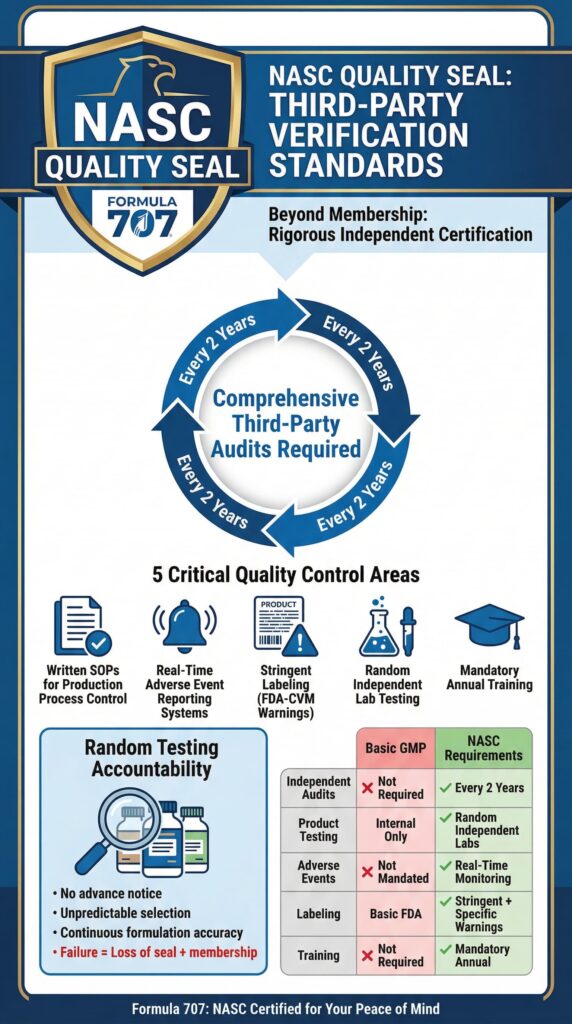
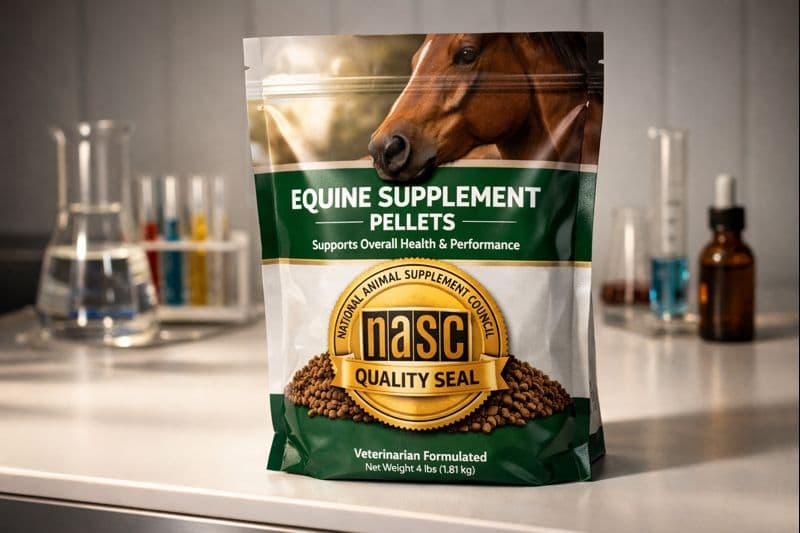
Formula 707 displays the National Animal Supplement Council (NASC) Quality Seal on their products—a designation requiring significantly more than simple membership. To maintain NASC certification, manufacturers must pass comprehensive independent third-party audits every two years and demonstrate ongoing compliance with rigorous standards.[4]
The NASC audit process evaluates five critical quality control areas. Companies must maintain written Standard Operating Procedures (SOPs) for production process control, implement adverse event reporting systems to monitor product safety in real-time, comply with stringent labeling guidelines including FDA-CVM recommended warnings, and submit to random product testing by independent laboratories to verify ingredients meet label claims.[5]
This random testing component deserves particular attention. NASC-certified companies cannot predict when their products will be selected for independent analysis, creating continuous accountability for maintaining formulation accuracy. Products failing random testing risk losing the Quality Seal designation and NASC membership.[6]
| Quality Measure | Basic GMP Compliance | NASC Quality Seal Requirements |
|---|---|---|
| Independent Audits | Not required | Comprehensive third-party audit every 2 years |
| Product Testing | Internal testing at manufacturer discretion | Random independent lab testing with no advance notice |
| Adverse Event Tracking | Not mandated | Required real-time monitoring and reporting system |
| Labeling Standards | Basic FDA compliance | Stringent guidelines plus specific ingredient warnings |
| Continuing Education | Not required | Mandatory annual NASC-facilitated training |
What Stability Data Formula 707 Does (and Doesn’t) Publicly Share
Formula 707 does not publish detailed batch-level stability curves, accelerated testing protocols, or ingredient degradation rates on their website or product packaging. This lack of transparency isn’t unique to Formula 707—most equine supplement manufacturers follow similar practices regarding proprietary testing data.[7]
What Formula 707 does provide is NASC certification, which requires maintaining quality control manuals with documented SOPs, manufacturing products in their dedicated Colorado equine facility under controlled conditions, and product labeling that includes guaranteed analysis showing minimum nutrient levels at time of manufacture.[8]
The company’s website emphasizes their products are “backed by research” and “university-studied,” particularly for MetaStable Pellets. Two peer-reviewed university studies validate MetaStable’s formulation. A 2020 Michigan State University study published in the Journal of Equine Veterinary Science demonstrated that horses with EMS receiving leucine and resveratrol supplementation showed significant weight loss and lower insulin responses during oral sugar testing.[9] More recently, a December 2025 randomized, placebo-controlled trial published in Equine Veterinary Journal found that 38 ponies with EMS showed improved metabolic markers and weight loss over 60 days when supplemented with leucine, resveratrol, and pyridoxine (vitamin B6)—the exact ingredient combination found in MetaStable Pellets.[10]
For consumers seeking batch-specific quality data, requesting a Certificate of Analysis (COA) directly from Formula 707 customer service (970-284-5575) represents the most direct approach to accessing testing information beyond what appears on product labels.
How to Interpret Certificates of Analysis for Equine Supplements
A Certificate of Analysis serves as your supplement’s quality report card—documenting that a specific batch underwent testing and confirming its quality characteristics. Understanding how to read COAs empowers horse owners to verify product integrity beyond manufacturer claims.[11]
Every legitimate COA should include specific batch identification (lot number matching your product container), product name and manufacturing date for traceability, detailed test results with actual numeric values (not just “PASS”), established specifications or limits for each parameter tested, and certification from an accredited laboratory ideally holding ISO/IEC 17025 accreditation.[12]
Weak COAs rely on vague language like “verified via raw material” or “in-process checks” rather than finished-product testing. Strong COAs provide numeric results with units (e.g., “Biotin: 22.3 mg/scoop; Spec: ≥20 mg/scoop; Method: HPLC”), name the specific analytical method used (HPLC, ICP-MS, etc.), and include authorized sign-off with date.[12]
For Formula 707 Hoof Health Pellets containing biotin as a key ingredient, a quality COA would confirm actual biotin content per serving using validated analytical methods, not simply state the ingredient meets specification without providing measured values. The difference matters when assessing whether your horse receives therapeutic biotin levels (typically 20-30mg daily for hoof support).
| COA Component | What to Look For | Red Flags |
|---|---|---|
| Laboratory | ISO 17025 accredited third-party lab with contact information | No lab name listed, or manufacturer’s in-house lab only |
| Test Results | Numeric values with units (mg, ppm, %) | “PASS” without actual measurements; “verified via ingredient supplier” |
| Specifications | Clear limits (≥20 mg biotin/serving) | “Meets internal standards” without defined limits |
| Methodology | Named methods (HPLC-UV, ICP-MS) | “Standard testing procedures” without specifics |
| Batch Traceability | Lot number, manufacture date, expiration date | Generic COA not tied to specific batch |
The Science of Supplement Degradation: What Happens Over Time
Vitamins and minerals don’t suddenly become ineffective on expiration dates—they lose potency gradually through chemical degradation processes. Understanding these mechanisms helps horse owners make informed decisions about supplement usage and storage.[1]
Biotin (vitamin B7), a primary ingredient in Formula 707 Hoof Health Pellets, demonstrates relatively good stability compared to more fragile vitamins. Research on biotin stability in various formulations shows minimal degradation under proper storage conditions, though phosphate buffers and extreme pH levels can enhance breakdown.[1]
Vitamin B6 (pyridoxine), featured in Formula 707 MetaStable and Calming Pellets, demonstrates good stability in its pyridoxine form compared to more reactive vitamin forms. Pyridoxine’s chemical structure makes it suitable for pelleted supplements with extended shelf life, maintaining bioavailability for horses throughout the product’s stated expiration date.[1]
Several environmental factors accelerate nutrient degradation. Moisture absorption affects pelleted supplements more than tablets or capsules, which is why manufacturers specify “store in a cool, dry place.” Oxygen exposure through repeatedly opened containers creates oxidative stress on vitamins like vitamin E and selenium. Light exposure, particularly UV light, degrades light-sensitive vitamins including vitamin A and riboflavin. Heat accelerates all chemical reactions—including degradation—following the principle that every 10°C temperature increase roughly doubles reaction rates.[1]
Quality manufacturers account for predictable degradation by using ingredient overage. High-quality supplements add 10-20% extra vitamins and minerals beyond label claims to ensure products still meet specifications at expiration. This practice means a supplement listing 20mg biotin per serving might actually contain 22-24mg when manufactured, maintaining at least 20mg throughout its shelf life.[13]
Storage Conditions That Preserve Supplement Potency
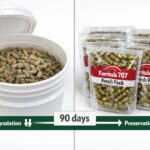
Proper storage can significantly extend supplement effectiveness beyond listed expiration dates, while poor storage accelerates degradation regardless of quality manufacturing. Formula 707’s rice bran-based pellets require the same careful handling as any nutrient-dense equine supplement.[14]
Temperature control represents the single most important storage factor. Supplements should be stored at 50-70°F (10-21°C) when possible. Barn storage during summer heat or winter freezing can compromise stability—consider storing in climate-controlled tack rooms or houses if barn temperatures regularly exceed 80°F or drop below 40°F.[2]
Humidity management prevents moisture absorption that causes clumping, bacterial growth, and accelerated vitamin breakdown. Relative humidity should stay below 60% in storage areas. Never store supplements near water sources, in bathrooms with shower steam, or in kitchens where cooking creates humidity. Formula 707’s sealed bags and containers should remain closed except during feeding to minimize moisture exposure.[2]
Container integrity matters more than many horse owners realize. Always keep supplements in original containers that include desiccant packets—these packets actively absorb moisture protecting supplement quality. Transferring pellets to decorative containers or feed bins eliminates this protection and exposes supplements to air oxidation. If you must transfer supplements for feeding convenience, use airtight containers and move only small quantities you’ll use within one week.[2]
Light protection prevents photodegradation of sensitive nutrients. Store supplements in closed cabinets or containers rather than on open shelves exposed to barn lights or sunlight. Vitamin B6 in Formula 707 Calming Pellets demonstrates sensitivity to prolonged light exposure, making proper storage essential for maintaining potency.[1]
Shelf Life Reality: When Supplements Actually Lose Effectiveness
Research on over 100 prescription medications found that 90% remained suitable for use even 15 years after expiration dates when stored properly. While supplements lack this extensive data, the principle holds—expiration dates represent conservative estimates of when manufacturers guarantee full potency, not when products suddenly become ineffective or unsafe.[15]
The typical 2-year shelf life for vitamin supplements like Formula 707 products assumes storage under recommended conditions. Supplements stored in hot, humid barns may lose potency months before expiration, while those kept in ideal conditions could maintain effectiveness 6-12 months past printed dates.[2]
Pelleted supplements like Formula 707’s entire product line generally maintain stability better than powders or liquids, though proper container sealing remains critical. Chewable and gummy vitamins (not applicable to Formula 707’s pelleted products) degrade faster than tablets or pellets due to moisture absorption.[2]
Certain vitamins break down faster than others regardless of formulation. Vitamin C, vitamin K, and vitamin B1 (thiamine) show more rapid degradation than biotin, vitamin B6, or most minerals. Formula 707 Calming Pellets containing thiamine should be monitored particularly carefully for signs of degradation including off-odors, color changes, or unusual texture.[1]
Expired supplements typically won’t harm your horse—they simply deliver reduced nutrient levels. For horses requiring specific therapeutic levels of nutrients (like biotin for hoof recovery or magnesium for metabolic support), using expired supplements may provide insufficient nutrition despite regular administration.[1]
Independent Testing Resources for Supplement Verification
Horse owners seeking to verify supplement quality beyond manufacturer claims have several independent testing options available, though costs vary significantly.
Third-party laboratories specializing in dietary supplement analysis offer comprehensive testing services. Eurofins, a global testing network, provides supplement potency testing, heavy metal screening, and microbiological analysis with ISO 17025 accreditation. Labstat International focuses specifically on dietary supplement and natural health product testing including stability studies and shelf life determination. These commercial labs typically charge $500-2000 per comprehensive analysis depending on parameters tested.[2]
For budget-conscious horse owners, requesting manufacturer COAs represents a more accessible verification approach. Contact Formula 707’s Colorado customer support (970-284-5575 or info@formula707.com) and provide your product’s lot number (printed on container) to request batch-specific testing documentation.[3]
University equine nutrition programs occasionally conduct independent supplement evaluations as part of research projects. Following equine nutrition departments at institutions like Kentucky Equine Research or UC Davis School of Veterinary Medicine may reveal publicly available supplement testing data.[1]
| Testing Approach | Cost Range | Information Provided | Best For |
|---|---|---|---|
| Request Manufacturer COA | Free | Batch-specific test results from manufacturer’s quality control | Verifying a specific product batch meets label claims |
| Third-Party Lab Testing | $500-2000 | Independent analysis of potency, purity, contaminants | Concerns about product quality or suspected degradation |
| NASC Quality Seal Verification | Free | Confirms company passed independent audit and random testing | Evaluating overall company quality commitment |
| University Research Data | Free (if publicly available) | Independent efficacy and sometimes quality testing | Academic validation of supplement ingredients/formulations |
Formula 707’s Manufacturing Quality Control Beyond Stability Testing
Formula 707 manufactures all products in their dedicated equine supplement facility in La Salle, Colorado—a practice providing greater quality control than companies outsourcing production to contract manufacturers. In-house manufacturing allows Formula 707 to directly oversee every production stage from ingredient verification through final packaging.[3]
The company’s NASC certification requires maintaining comprehensive quality control manuals documenting production processes, ingredient supplier qualification procedures, and finished product testing protocols. While Formula 707 doesn’t publish these internal documents, NASC auditors verify their existence and implementation during biannual facility inspections.[4]
Formula 707’s use of rice bran and wheat middlings as base carriers in products like MetaStable and Calming Pellets provides natural stability advantages compared to carriers containing simple sugars or moisture-attracting ingredients. Rice bran’s low moisture content and natural antioxidants (vitamin E, oryzanol) may actually help stabilize other formula components during storage.
When to Replace Supplements: Practical Guidelines
Visual and sensory changes often indicate supplement degradation before expiration dates. Discard supplements showing strong off-odors different from the product’s normal scent, unusual color changes (darkening, fading, or spots), visible mold growth (fuzzy patches, discoloration), hard clumping beyond normal pellet adhesion, or excessive powdering and crumbling.[2]
For supplements without visible degradation, consider replacement based on storage conditions and usage patterns. Replace products stored in hot barns (regularly exceeding 80°F) within 12 months regardless of expiration date. Discard supplements exposed to moisture (containers left open, water contact, barn flooding) immediately regardless of appearance. Replace partially used containers that have been open longer than 6 months even if expiration date hasn’t passed. Consider replacing supplements 3-6 months past expiration if your horse depends on specific therapeutic nutrient levels.[2]
For horses with critical nutritional needs—including those recovering from laminitis requiring therapeutic biotin levels or metabolic horses needing consistent magnesium and chromium support—prioritize supplement freshness over cost savings from using older products. The risk of insufficient nutrient delivery outweighs modest financial savings.
The Transparency Gap: What Supplement Companies Should (But Often Don’t) Provide
Consumer demand for transparency in supplement quality could drive industry improvements if horse owners consistently requested specific information from manufacturers. Beyond basic guaranteed analysis, companies could provide stability study summaries showing ingredient degradation curves over shelf life, actual overage percentages used for each nutrient to account for degradation, batch-specific COAs accessible via lot number lookup on websites, and detailed storage recommendations based on actual stability testing data rather than generic guidelines.[1]
Formula 707’s NASC certification demonstrates commitment to quality standards, but like most equine supplement companies, they maintain proprietary control over detailed testing protocols and stability data. This industry-wide practice creates information asymmetry between manufacturers possessing comprehensive testing data and consumers relying on limited label information.[16]
Horse owners can encourage greater transparency by specifically requesting COAs when purchasing supplements, asking customer service representatives about stability testing protocols and overage practices, supporting companies that voluntarily publish detailed testing information, and providing feedback to manufacturers that transparency influences purchasing decisions.[11]
Making Informed Supplement Decisions Based on Available Information
In the absence of published stability data for Formula 707 products, horse owners can still make informed quality assessments using available information. NASC certification confirms independent audit compliance and random testing oversight—meaningful verification beyond simple manufacturer claims. In-house Colorado manufacturing provides quality control advantages over outsourced production common in the supplement industry. University research on MetaStable ingredients (leucine, B6, resveratrol) validates ingredient efficacy for metabolic support. Established company history since 1946 suggests sustained product consistency and quality standards.[3]
Compare these quality indicators across supplement options when choosing products for your horse’s needs. A NASC-certified supplement from an established manufacturer with in-house production generally offers better quality assurance than uncertified products from companies without verifiable quality standards.[4]
Remember that the best supplement delivers appropriate nutrients in bioavailable forms at therapeutic dosages for your horse’s specific needs. Stability testing and quality verification ensure those nutrients actually reach your horse at labeled levels—making informed supplement selection a two-step process of choosing effective ingredients AND reliable quality.
Conclusion
Formula 707’s NASC certification, in-house Colorado manufacturing, and university-backed ingredient research provide measurable quality assurance even without published stability testing data. Understanding how supplements degrade over time, what Certificate of Analysis documents reveal about product quality, and which storage conditions preserve potency empowers you to maximize supplement effectiveness for your horse.
While complete transparency in stability testing remains uncommon across the equine supplement industry, you can actively protect your investment by requesting batch-specific COAs, storing supplements in cool, dry, sealed containers away from light and moisture, monitoring for visual signs of degradation regardless of expiration dates, and replacing supplements that have been compromised by poor storage conditions even before expiration. For horses requiring therapeutic nutrient levels—whether recovering from laminitis, managing metabolic disorders, or addressing specific health concerns—prioritize supplement freshness and verified quality over cost savings. The difference between label claims and actual delivered nutrition directly impacts your horse’s health outcomes.
Ready to give your metabolic horse proven support backed by university research? Get Formula 707 MetaStable Pellets today and see the difference NASC-certified quality can make in managing insulin resistance and supporting healthy weight loss.
Formula 707 NASC Certification FAQs
Does Formula 707 publish stability testing data for their supplements?
Formula 707 does not publicly share detailed stability curves or accelerated testing protocols for their products, which is standard industry practice for most equine supplement manufacturers. However, their NASC certification requires maintaining quality control documentation and passing independent audits every two years, ensuring products meet quality standards even without published stability data. Horse owners can request batch-specific Certificates of Analysis by contacting Formula 707 customer service at 970-284-5575.
How long do Formula 707 supplements actually stay effective after the expiration date?
Formula 707 supplements stored properly in cool, dry conditions typically maintain reasonable potency for 6-12 months past printed expiration dates, though the company only guarantees full nutrient levels until expiration. Research on vitamin supplements shows gradual potency loss rather than sudden ineffectiveness after expiration. For horses requiring therapeutic nutrient levels for conditions like laminitis or metabolic disorders, replacing supplements near or past expiration ensures adequate nutrition delivery.
What does NASC certification tell me about Formula 707 supplement quality?
NASC Quality Seal certification confirms Formula 707 passes comprehensive third-party audits every two years, maintains documented quality control procedures, and submits to random independent laboratory testing without advance notice. This verification provides meaningful quality assurance beyond manufacturer claims, though NASC certification focuses on overall quality systems rather than specifically requiring published stability testing. NASC-certified supplements generally demonstrate better quality consistency than uncertified products.
Should I refrigerate Formula 707 pellets to extend their shelf life?
Formula 707 pelleted supplements do not require refrigeration and should be stored at room temperature in cool, dry conditions (50-70°F ideal). Refrigeration isn’t recommended for pelleted supplements because removing cold products to room temperature creates condensation on pellets, introducing moisture that accelerates degradation. Keep Formula 707 products in their original sealed containers in climate-controlled areas away from extreme heat, humidity, and direct sunlight for optimal stability.
How can I tell if my Formula 707 supplement has degraded before the expiration date?
Visible signs of Formula 707 supplement degradation include strong off-odors different from normal product scent, unusual color changes (darkening, fading, or discolored spots), hard clumping beyond typical pellet adhesion, excessive powdering or crumbling texture, or any visible mold growth. Supplements exposed to moisture, high heat (barn storage in summer), or left in open containers for extended periods often degrade before expiration dates despite appearing normal. When in doubt about supplement quality, request a fresh batch to ensure your horse receives full nutrient potency.
Formula 707 NASC Certification Citations
- A quality dietary supplement: before you start and after it’s marketed—a conference report – PMC
- Stability Testing for Dietary Supplements & NHP – Labstat International Inc
- Formula 707 – Home
- NASC Quality Seal | NASC LIVE
- National Animal Supplement Council (NASC) – SmartPak
- What is NASC? (National Animal Supplement Council) | PetMD
- John Ewing Company | LinkedIn
- Formula 707 Horse Supplements – Big Dee’s
- Investigation of the Effects of a Dietary Supplement on Insulin and Adipokine Concentrations in Equine Metabolic Syndrome/Insulin Dysregulation – ScienceDirect
- Leucine, pyridoxine and resveratrol supplementation alter metabolic parameters in ponies with equine metabolic syndrome – Equine Veterinary Journal
- Understanding the Certificate of Analysis (COA): A Comprehensive Guide
- Good vs. Bad Supplement CoAs: How to Read a Certificate of Analysis – Blue Ocean Regulatory Inc.
- Factors to consider in setting adequate overages of vitamins and minerals in dietary supplements – ResearchGate
- MetaStable® Pellets – Formula 707®
- Drug expiry debate: the myth and the reality – PMC
- About Us – Formula 707®




Leave a Reply