
Key Takeaways:
- Miami’s tropical climate with 70-78% humidity and temperatures reaching 90°F demands specialized supplement storage strategies to prevent mold, clumping, and nutrient degradation
- Store all EMS horse supplements in cool, dry locations between 50-70°F with humidity below 50%, using airtight containers with desiccant packs when available
- Purchase smaller quantities (2-4 week supply) during summer months to ensure maximum freshness and potency
- Never leave supplements in hot vehicles or direct sunlight—use insulated coolers for transport and request shaded delivery locations
- Powders and pellets tolerate heat better than liquids or pastes, but all forms require protection from Miami’s extreme humidity
Article Summary: Managing EMS horse supplements in Miami’s tropical climate requires vigilant storage practices because heat and humidity above 70% can rapidly degrade essential nutrients like magnesium, chromium, and vitamin E that are critical for metabolic health. Store supplements in air-conditioned spaces or refrigerators, buy small quantities, use airtight containers, and never expose products to direct sunlight or temperatures above 70°F to maintain potency and safety.[1][2]
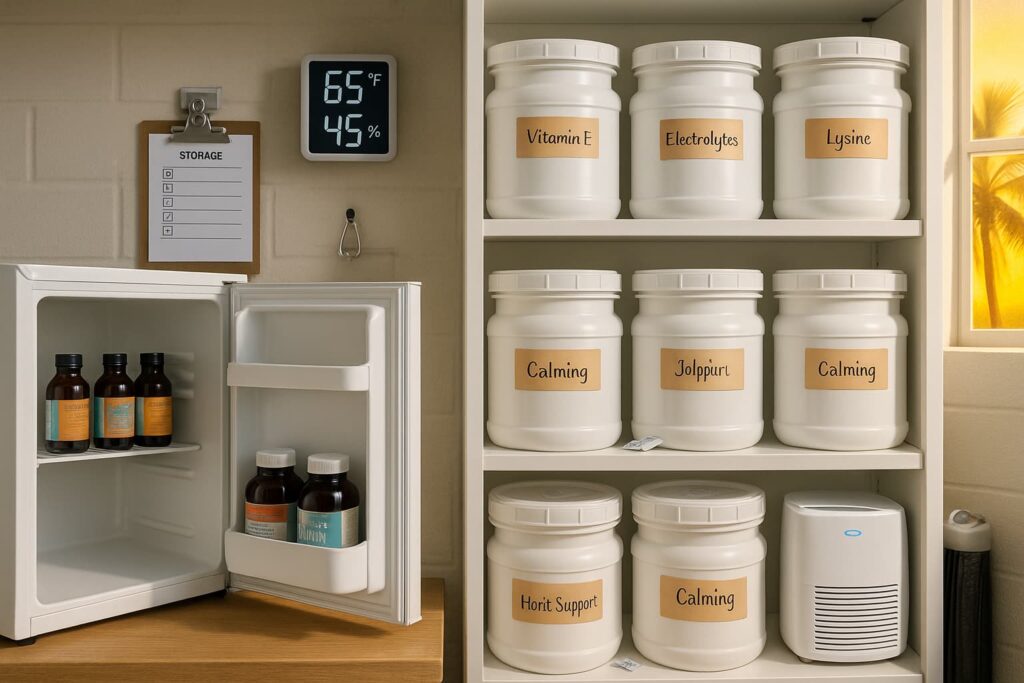
Understanding Miami’s Challenging Climate for Supplement Storage
Miami’s tropical monsoon climate creates one of the most demanding environments in the United States for storing equine supplements.[3] The city experiences year-round high humidity levels ranging from 70% to 78%, with peak humidity occurring in September.[4] Summer temperatures regularly climb into the high 80s and low 90s, with August averaging 89°F.[5] This combination of heat and humidity poses serious risks to supplement integrity. When the temperature exceeds 70°F and humidity rises above 50%, the conditions become ideal for mold growth, nutrient degradation, and chemical breakdown of active ingredients.[6] For horses with Equine Metabolic Syndrome, maintaining supplement potency is not just about value—it directly impacts their health management and laminitis prevention. The unique challenge for EMS horses in Miami is that the supplements they need most—magnesium, chromium, vitamin E, and metabolic support formulas—are also among the most sensitive to heat and moisture degradation.[7]
Why Proper Storage Matters for EMS Horse Supplements
Equine Metabolic Syndrome is a serious endocrinopathy characterized by insulin dysregulation, regional adiposity, and increased laminitis risk.[8] Horses with EMS require carefully formulated supplements to support glucose metabolism, reduce inflammation, and provide essential micronutrients that forage alone cannot deliver.[9] When supplements degrade due to improper storage, several problems occur. Vitamins A and E break down rapidly when exposed to heat and sunlight, losing their antioxidant properties that help combat oxidative stress in metabolic horses.[2] Minerals can become less bioavailable when moisture causes chemical changes in their molecular structure. Probiotics die off completely in high heat, rendering gut health supplements useless.[10] For the Miami horse owner managing EMS, this means that a $50 supplement bucket left in a hot barn could lose half its nutritional value within weeks during summer months. Beyond wasted money, inadequate supplementation can lead to metabolic complications and increased laminitis episodes.
The Science Behind Supplement Degradation in Tropical Climates
How Heat Affects Different Supplement Types
Powdered and pelleted supplements demonstrate better heat tolerance than liquid or paste formulations.[1] These dry forms can withstand brief exposure (several hours) to temperatures above 70°F without significant molecular structure changes. However, prolonged exposure to Miami’s sustained heat still causes problems. Liquid supplements and pastes are particularly vulnerable to high temperatures. Heat can cause liquids to separate, leak from containers, or undergo chemical reactions that reduce potency.[11] Some liquid vitamins can lose up to 50% of their effectiveness when stored above 80°F for extended periods.
The Humidity Factor
Humidity presents an even greater threat than heat alone for supplement storage in Miami. With average relative humidity staying between 70-78% year-round, moisture infiltration becomes inevitable without proper protection.[12] Hygroscopic supplements—those that naturally attract and absorb moisture from the air—are especially problematic. Electrolyte powders, for example, can pull water directly out of Miami’s humid air, causing clumping, caking, and eventually mold growth.[1] Once mold develops, the entire supplement becomes unsafe to feed. This creates quite different supplement requirements than we might see in hot dry climates.
Nutrient-Specific Vulnerabilities
Different nutrients have varying sensitivity levels to environmental conditions. Fat-soluble vitamins (A, D, E, K) oxidize rapidly in heat and light, becoming rancid and losing biological activity.[2] B-vitamins are more stable but can still degrade in humid conditions. Minerals like selenium and chromium—critical for EMS management—maintain better stability but can become less bioavailable when moisture alters their chemical form.[13]
| Supplement Type | Heat Sensitivity | Humidity Sensitivity | Miami Storage Priority |
|---|---|---|---|
| Powders (Magnesium, Chromium) | Moderate | High | Airtight containers with desiccant |
| Pellets (Balancers, Blends) | Low-Moderate | High | Sealed bins, check for clumping |
| Liquids (Fish oil, Vitamin E) | High | Moderate | Refrigeration recommended |
| Pastes (Emergency supplements) | High | Low | Cool, shaded storage |
| Probiotics | Very High | High | Refrigerate or purchase small quantities |
Essential Storage Guidelines for Miami Horse Owners
Creating the Ideal Storage Environment
The gold standard for supplement storage is maintaining temperatures between 50-70°F with humidity levels of 40-50%.[1] For most Miami-area barns, achieving these conditions naturally is impossible. Here’s how to create optimal storage: Use air-conditioned spaces whenever possible. Moving supplements from the barn to your home’s climate-controlled garage, pantry, or dedicated storage area provides the best protection. If you must store supplements at the barn, consider installing a small window air conditioning unit in your tack room or investing in a dedicated supplement refrigerator.[2] Avoid ground-level storage. Keep all supplement containers elevated on pallets or shelves to promote air circulation and protect against flooding during Miami’s heavy summer rains.[2] Ground-level storage also invites pest problems and moisture wicking from concrete floors.
Container Selection and Sealing Techniques
Transfer supplements from manufacturer packaging into food-grade, airtight containers immediately upon opening. Gamma seal lids—screw-top lids that create an airtight seal—work excellently for large feed bins and provide easy access while maintaining protection.[1] For supplements that come in resealable pouches, carefully follow the resealing instructions. Many quality supplements include inner plastic liners with zip-lock tops or twist ties. Always reseal the inner liner completely before replacing the outer bucket lid.[1] If a desiccant packet came with your supplement, leave it in the container—these silica gel packets actively absorb moisture and provide critical protection in humid environments.
The Two-Week Rule for Summer Storage
During Miami’s brutal summer months (May through October), implement the two-week rule: purchase only enough supplement to last two to four weeks.[14] While buying larger quantities saves money per serving, the savings evaporate when supplements lose potency or develop mold halfway through a three-month supply. Smaller purchases ensure you’re always feeding fresh, potent supplements when your EMS horse needs them most.[10] Many online retailers and local feed stores offer subscription services or frequent buyer programs that can offset the higher per-unit cost of smaller containers.
Transport and Delivery Protection Strategies
Managing Shipped Supplements
Online shopping for horse supplements offers convenience and often better prices, but shipping to Miami requires careful planning. When placing orders, include delivery instructions requesting that packages be left in shaded, covered areas rather than on sun-exposed porches.[1] Consider setting up a cooler station at your delivery location. Leave a clean, large cooler with ice packs and a note for delivery drivers to place supplement packages inside. This simple step can prevent heat damage during the crucial hours between delivery and when you retrieve packages.[1] Schedule deliveries strategically. If possible, arrange for packages to arrive on days when you’ll be home to receive them immediately. Morning deliveries are preferable to afternoon ones, as they spend less time exposed to peak heat.
Safe Vehicle Transport
Never leave supplements in a parked vehicle during Miami’s summer. Interior car temperatures can soar to 140°F within 30 minutes, even with windows cracked.[15] This extreme heat can permanently damage supplements in just a single trip from store to barn. Always use an insulated cooler with ice packs when transporting supplements, especially during summer months. Place supplements in the cooler before entering the store, and transfer them directly to climate-controlled storage immediately upon arrival.[1]
Supplement Form Selection for Tropical Climates
Powders vs. Pellets vs. Liquids
When possible, choose pelleted forms of supplements over powders for Miami storage. Pellets resist humidity better than loose powders because their compressed form provides less surface area for moisture absorption.[16] However, pellets can still clump and mold if not properly stored, so the other storage precautions remain essential. If you’re using powder supplements like straight magnesium oxide or chromium yeast, consider transferring them to smaller airtight jars and keeping only a week’s supply at the barn. Store the bulk container at home in air-conditioning, refilling your barn supply weekly.[7] Liquid supplements, particularly omega-3 oils and liquid vitamin E, benefit from refrigeration in Miami’s climate. Many liquid supplements remain stable when refrigerated and can actually last longer than their shelf life when properly chilled.[1] For the best supplements for insulin resistant horses, proper storage of liquid formulations ensures maximum effectiveness.
Understanding Supplement Shelf Life
Unopened supplements typically have a shelf life of 18-24 months from manufacture date when stored properly.[10] However, in Miami’s climate, once opened, that shelf life can drop to just 2-3 months for powder formulations and 1-2 months for liquids if not refrigerated. Always check expiration dates before purchasing. Buy from retailers with high turnover to ensure you’re getting the freshest products. At home, implement a “first in, first out” (FIFO) system, using older supplements before newer ones.[2]
Special Considerations for EMS-Specific Supplements
Magnesium Supplements
Magnesium is one of the most critical supplements for EMS horses, supporting insulin sensitivity and helping prevent muscle cramps during weight loss programs.[7] Fortunately, magnesium oxide and other magnesium forms demonstrate good heat stability. The primary concern is moisture causing clumping. Store magnesium supplements in completely airtight containers with desiccant packets. Even minor humidity exposure can cause the powder to cake into hard lumps that are difficult to measure accurately.[1]
Chromium and Metabolic Blends
Chromium yeast, a key ingredient in many EMS support supplements, maintains reasonable stability in heat but requires protection from moisture.[13] Many commercial metabolic blends combine chromium with other nutrients in pelleted form, which offers good storage stability for Miami conditions when kept sealed and dry. Dedicated filler-free supplements to support horses with metabolic disorders often use concentrated formulations that require smaller feeding amounts, which can be an advantage in tropical storage situations since you’re opening the container less frequently.
Omega-3 and Fish Oil Supplements
Omega-3 fatty acids oxidize rapidly when exposed to heat, light, and air, becoming rancid and potentially harmful.[7] For Miami horse owners, this means omega-3 supplements absolutely require refrigeration after opening. Store the bottle in a refrigerator, and only remove it briefly to pour the daily serving. Signs of omega-3 rancidity include a strong fishy smell (normal fish oil has only a mild odor), dark color, and thick, sticky consistency. If you notice these changes, discard the product immediately—rancid omega-3s can actually promote inflammation rather than reduce it.[2]
| EMS Supplement Category | Recommended Form for Miami | Storage Location | Maximum Open Shelf Life |
|---|---|---|---|
| Magnesium | Powder in airtight container | Cool, dry location | 3 months |
| Chromium/Metabolic Blend | Pellets | Sealed bin, barn or home | 2-3 months |
| Omega-3/Fish Oil | Liquid | Refrigerator | 1-2 months |
| Vitamin E | Powder or liquid | Cool, dark location or refrigerator | 2 months |
| Ration Balancer | Pellets | Sealed bin with desiccant | 3 months |
| Probiotic | Individual packets preferred | Refrigerator if possible | 1 month bulk, as needed packets |
Recognizing Spoiled or Degraded Supplements
Visual and Olfactory Warning Signs
Regularly inspect your supplements for signs of degradation. Powders should flow freely without clumps larger than small pebbles. Large, hard clumps indicate significant moisture exposure and possible mold contamination.[2] Check for visible mold growth, which may appear as white, green, gray, or black fuzzy patches or spots. Any visible mold means the entire container must be discarded immediately—mold toxins can spread throughout the product even if you can’t see them.[2] Smell your supplements periodically. Fresh supplements have a mild, characteristic odor based on their ingredients. Rancid smells, sour odors, or musty scents indicate spoilage.[1] Trust your nose—if something smells off, don’t feed it.
Performance and Physical Changes
Watch for changes in color, particularly darkening or fading, which can indicate nutrient degradation from light or heat exposure. Pellets should maintain their firm texture—soft, crumbling, or sticky pellets suggest moisture damage.[2] If you notice your horse’s condition declining despite consistent supplement feeding, check the supplements themselves—degraded products may have lost their nutritional potency even if they look acceptable.[10]
Seasonal Storage Strategy Adjustments
Summer Storage (May-October)
Miami’s wet season brings the most challenging storage conditions. During these months, check supplements twice weekly for any signs of moisture infiltration, clumping, or mold.[18] Consider moving all supplements to air-conditioned storage if possible, even if it means keeping them at home and bringing daily servings to the barn in a small container. Buy the smallest available containers during summer. The cost per serving may be higher, but you’ll avoid the false economy of throwing away half a large bucket that went bad.[14]
Winter Storage (November-April)
Miami’s drier season offers some relief from extreme humidity, but storage vigilance remains important. Humidity levels still average 67-73%, which is well above the ideal 40-50% range.[4] Continue using airtight containers and desiccant packets, though you may be able to extend to 6-8 week purchase quantities if storage conditions are excellent. Winter is a good time to deep-clean all supplement storage areas, bins, and containers, preparing for the challenging summer months ahead.[2]
Setting Up a Proper Supplement Storage Area
Barn-Based Storage Solutions
If you must store supplements at your barn, designate the coolest, driest area available. Corner locations away from sun-exposed walls work best. Install battery-operated hygrometers (humidity meters) to monitor conditions—these inexpensive devices provide valuable data about your storage environment.[2] Add a small dehumidifier if electrical access allows. Even a modest 30-pint dehumidifier can significantly reduce humidity in a 10×10 tack room, providing much better storage conditions.[2] Keep supplement bins elevated at least 6-12 inches off the floor using pallets, plastic shelving units, or commercial feed bin stands. This protects against flooding and improves air circulation.[2]
Home Storage Options
For horse owners with the space, keeping supplements at home in climate-controlled conditions provides the best protection. Designate a pantry, closet, or garage corner as your equine supplement area. Use labeled bins and implement a FIFO rotation system to ensure nothing expires unused.[2] Prepare daily or weekly supplement portions in small, labeled containers that you transport to the barn. This approach minimizes the number of times you open the main storage containers, reducing humidity exposure.[1]
Cost-Benefit Analysis: Proper Storage vs. Replacement Costs
Implementing proper storage practices requires some investment—airtight containers, a small refrigerator, or dehumidifier all cost money. However, compare these one-time or minimal ongoing costs to the expense of replacing degraded supplements. A typical EMS horse might receive $100-200 worth of supplements monthly. If improper storage causes even 25% potency loss, you’re effectively wasting $25-50 monthly, or $300-600 annually.[2] That same $300-600 could purchase all the storage equipment needed, with money to spare. Beyond financial considerations, proper storage ensures your horse receives full therapeutic benefit from supplements. For EMS horses prone to laminitis, this could mean the difference between stable metabolic control and a painful, expensive laminitis episode requiring veterinary intervention and extended stall rest.[9]
Rationale for Equine Metabolic Support
The goal of management for horses with EMS or insulin dysregulation is achieving and maintaining blood insulin and glucose levels as close to normal as possible. This requires not just appropriate dietary restriction and supplementation, but ensuring those supplements maintain their potency through proper storage. In hot, humid climates, this becomes even more critical as degraded supplements may fail to provide the metabolic support these horses desperately need.[17]
Creating a Supplement Management System
Inventory and Rotation Tracking
Develop a simple tracking system for your supplements. Label each container with the purchase date and expected expiration date. Keep a log (digital or paper) noting when you open each supplement and what you observe about its condition.[2] Set phone reminders to check supplement condition weekly during summer months and bi-weekly during winter. This regular monitoring catches problems early before entire containers are ruined.[1]
Vendor Selection for Tropical Climates
Build relationships with supplement vendors who understand tropical shipping challenges. Some companies use insulated packaging or cold packs for shipments to Florida and other hot-climate states.[16] Ask about shipping methods before ordering, especially for heat-sensitive products like probiotics and omega-3s. Consider local feed stores with high inventory turnover. Products sitting on store shelves in non-climate-controlled conditions may already have suffered storage damage before you purchase them. Stores with good sales volume ensure fresher products.[10]
Emergency Supplement Cooling During Power Outages
Hurricane Season Preparation
Miami’s Atlantic hurricane season runs June through November, coinciding with the most challenging supplement storage period.[3] Power outages can last days or even weeks after major storms, putting refrigerated supplements at risk and allowing barn temperatures to soar. Prepare an emergency supplement kit before hurricane season begins. For critical daily supplements, consider switching to single-serve packets that don’t require refrigeration during the storm season.[1] Keep a supply of ice and coolers ready to transfer refrigerated supplements into if power fails. After a power outage exceeding 4 hours, check all refrigerated supplements. If they’ve warmed to room temperature, evaluate them for safety. Many supplements can tolerate brief temperature excursions, but prolonged warming may require replacement.[19]
Conclusion
Managing horse supplements in Miami’s tropical climate requires dedication, proper equipment, and consistent monitoring, but the health of your EMS horse depends on receiving full nutritional support from fresh, potent supplements. By storing products in cool, dry, airtight conditions, purchasing appropriate quantities, protecting supplements during transport, and regularly inspecting for signs of degradation, you can successfully maintain supplement quality year-round. The investment in proper storage systems pays dividends through better metabolic control, reduced laminitis risk, and cost savings from fewer wasted products. Take control of your supplement storage today to give your EMS horse the best chance at long-term health and soundness in Miami’s challenging climate.
Miami EMS Horse Supplements with Tropical Weather Storage Guide FAQs
How long can horse supplements safely sit in a hot car in Miami before they’re damaged?
Horse supplements should never be left in a hot car in Miami for more than 30 minutes because interior temperatures can reach 140°F within that timeframe, causing permanent damage to heat-sensitive nutrients like vitamins A, E, and probiotics. Always use insulated coolers with ice packs for transport and move supplements to climate-controlled storage immediately upon reaching your destination.[1][15]
Can I store my EMS horse supplements in the barn tack room during Miami summers?
You can store EMS horse supplements in a barn tack room during Miami summers only if the space is climate-controlled to maintain temperatures between 50-70°F with humidity below 50%; otherwise, supplements stored in typical un-air-conditioned tack rooms will likely experience clumping, mold growth, and nutrient degradation within weeks, making home storage in air-conditioned spaces the safer choice.[2]
Do pelleted supplements store better than powders in Miami’s humid climate?
Yes, pelleted supplements generally store better than powders in Miami’s humid climate because their compressed form provides less surface area for moisture absorption, though both forms still require airtight containers with desiccant packets and proper storage conditions to prevent degradation in environments with 70-78% relative humidity.[16]
What Miami EMS horse supplements absolutely require refrigeration?
In Miami’s tropical climate, omega-3 fish oil supplements, liquid vitamin E products, and probiotic supplements absolutely require refrigeration after opening because these products rapidly degrade, oxidize, or lose live cultures when exposed to temperatures above 70°F, which is typical year-round in non-climate-controlled spaces.[7]
How can I tell if my horse supplements have gone bad in Miami’s heat and humidity?
You can tell if horse supplements have gone bad in Miami’s heat and humidity by checking for hard clumping, visible mold (white, green, or black fuzzy growth), rancid or sour odors, color changes, and sticky or soft texture in pellets, with any of these signs indicating the product should be immediately discarded as it may be unsafe or nutritionally compromised.[2]
Miami EMS Horse Supplements with Tropical Weather Storage Guide Citations
- Kentucky Performance Products. “What You Should Know About Storing Horse Supplements During the Hot Summer Months.” https://kppusa.com/storing-horse-supplements-summer/
- Mad Barn. “Feed Storage on Horse Farms: Best Practices to Keep Grain, Supplements & Hay Fresh.” https://madbarn.com/feed-storage-for-horse-farms/
- Wikipedia. “Climate of Miami.” https://en.wikipedia.org/wiki/Climate_of_Miami
- Weather and Climate. “Check Humidity in Miami (FL) by Month.” https://weather-and-climate.com/average-monthly-Humidity-perc,Miami,United-States-of-America
- Weather Spark. “Miami Climate, Weather By Month, Average Temperature (Florida, United States).” https://weatherspark.com/y/18622/Average-Weather-in-Miami-Florida-United-States-Year-Round
- Kentucky Performance Products. “Cold Weather Storage Tips for Your Supplements.” https://kppusa.com/cold-weather-storage-tips-supplements/
- Mad Barn. “How to Feed a Horse with Equine Metabolic Syndrome.” https://madbarn.com/how-to-feed-metabolic-horse/
- Merck Veterinary Manual. “Equine Metabolic Syndrome – Metabolic Disorders.” https://www.merckvetmanual.com/metabolic-disorders/equine-metabolic-syndrome/equine-metabolic-syndrome
- UC Davis School of Veterinary Medicine. “Equine Metabolic Syndrome.” https://ceh.vetmed.ucdavis.edu/health-topics/equine-metabolic-syndrome
- SmartPak. “Shelf Life of Vitamins and Supplements for Horses.” https://www.smartpakequine.com/learn-health/supplement-shelf-life
- Kentucky Performance Products. “Horse Supplement Storage Tips.” https://kppusa.com/horse-supplement-storage-tips/
- Florida Climate Center. “Humidity.” https://climatecenter.fsu.edu/topics/humidity
- National Center for Biotechnology Information. “ECEIM Consensus Statement on Equine Metabolic Syndrome.” https://pmc.ncbi.nlm.nih.gov/articles/PMC6430910/
- Horse and Rider. “Hot Weather Feed Storage.” https://horseandrider.com/horse-health-care/hot-weather-hurt-feed/
- UC Davis School of Veterinary Medicine. “Keeping Horses Healthy In Hot Weather.” https://ceh.vetmed.ucdavis.edu/health-topics/keeping-horses-healthy-hot-weather
- Getty Equine Nutrition. “Heat Alert Supplement Storage.” https://gettyequinenutrition.com/pages/heat-alert
- ECIR Group. “Treatment of EMS and Insulin Resistance.” https://www.ecirhorse.org/treatment-EMS.php
- Mad Barn. “14 Tips for Feeding & Caring for Horses in Hot Weather.” https://madbarn.com/feeding-horses-in-hot-weather/
- SmartPak. “Storing Equine Medications.” https://www.smartpakequine.com/learn-products/storing-equine-medications




Leave a Reply