
Key Takeaways
- Different professionals may recommend different hoof supplements based on their training focus—vets emphasize nutrition balance while farriers prioritize hoof mechanics
- Evaluate hoof supplements using a systematic framework: ingredient quality, dosing levels, comprehensive vs. targeted formulas, and compatibility with your horse’s current diet
- Most research-backed hoof supplements contain 15-30 mg biotin, methionine and lysine amino acids, and zinc/copper in a 3:1 ratio
- Results take 8-12 months as new hoof grows from coronary band to ground, requiring patience and consistent supplementation regardless of which product you choose
When your veterinarian suggests one hoof supplement but your farrier swears by something completely different, you’re stuck in the middle feeling confused about what’s actually best for your horse. The right hoof supplement choice depends on evaluating your horse’s specific nutritional gaps, understanding ingredient quality markers, and matching the supplement type to your horse’s existing diet rather than simply following brand loyalty from either professional.
Why Do Veterinarians and Farriers Recommend Different Hoof Supplements?
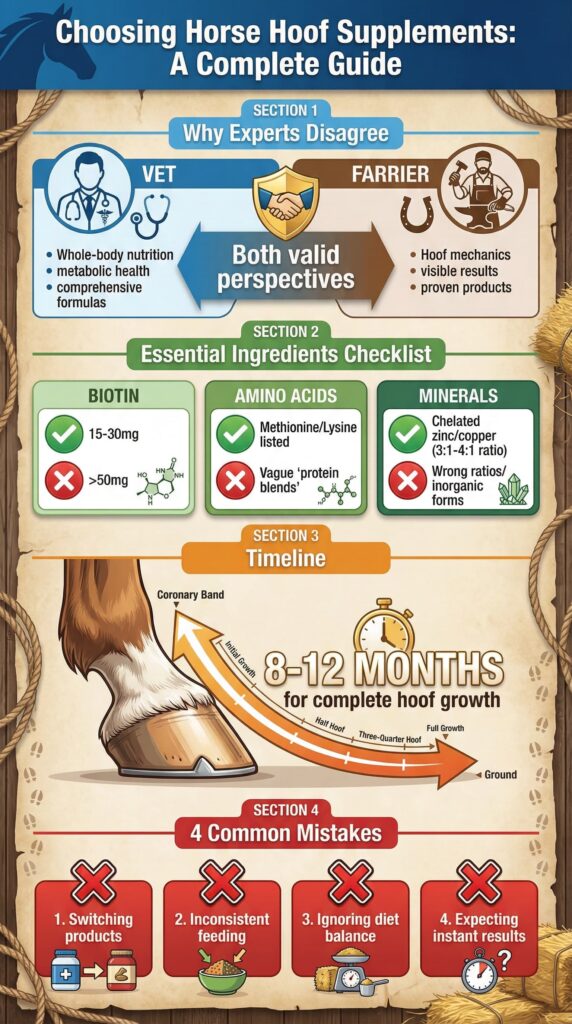
Veterinarians and farriers approach hoof health from different professional perspectives, which naturally leads to different product recommendations. Veterinarians typically focus on whole-body nutrition and metabolic health, often recommending comprehensive formulas that address potential dietary deficiencies across multiple nutrients [1]. Their training emphasizes biochemistry, nutrient interactions, and how systemic health affects hoof quality.
Farriers, on the other hand, observe hoof mechanics daily and see firsthand which products produce visible structural improvements in the hooves they trim and shoe. They often favor supplements they’ve seen work consistently across multiple horses, even if those products don’t align with textbook nutritional science. This practical, results-focused approach makes sense given their hands-on role.
Neither perspective is wrong—they’re just different lenses on the same problem. A veterinarian might recommend a vitamin/mineral balancer to correct zinc and copper ratios in a diet heavy in grass hay, while a farrier might suggest a biotin-heavy comprehensive formula because they’ve seen it strengthen dozens of weak hoof walls in their client base.
Common Areas of Professional Disagreement
The most frequent conflicts arise around comprehensive formulas versus targeted supplements. Veterinarians often prefer adding specific nutrients to an already-balanced diet, warning against over-supplementation that might create mineral imbalances [2]. Farriers frequently recommend all-in-one hoof formulas like Formula 707 or Farrier’s Formula, which contain multiple ingredients at fixed ratios.
Another point of disagreement involves biotin dosing. While research supports 15-30 mg daily for a 500 kg horse [3][4], some comprehensive supplements provide 50 mg or more. Veterinarians may question whether higher doses offer additional benefits or simply increase costs, while farriers point to anecdotal success with mega-dose formulas.
The chelated versus inorganic mineral debate also creates division. Veterinarians cite research showing chelated minerals (zinc proteinate, copper proteinate) have higher bioavailability than inorganic forms [5][6], but farriers may recommend products with inorganic minerals if they’ve seen good results at a lower price point.
Essential Nutrients in Research-Backed Hoof Supplements
Regardless of which professional made the recommendation, quality hoof supplements share common evidence-based ingredients. Understanding these core nutrients helps you evaluate whether a recommended product actually contains what your horse’s hooves need.
Biotin: The Foundation for Hoof Integrity
Biotin supplementation at 15-30 mg per day for a 500 kg horse consistently improves hoof horn quality and strength after several months of continuous feeding [3][4][7]. This B-vitamin acts as a coenzyme in keratin production, the structural protein that makes up hoof walls.
Studies show statistically significant improvements beginning around 6-9 weeks, with full benefits visible as the new hoof grows completely out—approximately 8-12 months depending on hoof growth rate [8][9]. Intermittent feeding doesn’t create hoof rings, but completely stopping biotin supplementation causes hooves to regress to their former state [10].
While horses produce biotin naturally in their hindgut, research demonstrates that oral mega-doses significantly improve hoof quality even in horses with normal blood biotin levels [10]. This suggests that hoof tissues benefit from higher biotin availability than body functions alone require.
Amino Acids: Building Blocks for Keratin Cross-Links
Methionine and lysine are essential amino acids that horses cannot manufacture, making dietary intake critical for hoof health [11][12]. Methionine contains sulfur, which enables cysteine production—the amino acid responsible for strong cross-links between keratin fibers in hoof horn [11].
Lysine supports collagen formation in connective tissues throughout the hoof capsule, including the laminae that connect the hoof wall to the coffin bone [12][13]. Threonine, another limiting amino acid, supports muscle mass and gut health, indirectly affecting nutrient absorption that benefits hooves [11].
Quality hoof supplements explicitly list these amino acids by name rather than hiding them under vague terms like “plant protein products.” Look for DL-methionine and L-lysine on ingredient panels to confirm their presence.
Trace Minerals: Zinc and Copper in Proper Balance
Zinc and copper work together as cofactors for keratin synthesis, and their ratio matters as much as their absolute amounts [14][15]. The optimal zinc-to-copper ratio is 3:1 to 4:1, providing approximately 300 mg zinc and 100 mg copper daily for a 500 kg horse [14][16].
Chelated forms (zinc proteinate, copper proteinate) demonstrate higher bioavailability than inorganic sulfate forms [5][6]. Research on yearlings showed 4% faster hoof growth when fed chelated minerals compared to inorganic sources [17].
Iron intake from forage and water can interfere with zinc and copper absorption. Horses consuming high-iron hay or well water may need supplemental zinc and copper even if their base diet appears balanced.
Evaluating Hoof Supplement Quality: A Systematic Framework
When faced with conflicting recommendations, use objective evaluation criteria rather than relying solely on professional opinion or brand recognition. This framework helps you compare any two supplements side by side.
| Evaluation Criteria | What to Look For | Red Flags to Avoid |
|---|---|---|
| Biotin Dose | 15-30 mg per daily serving for 500 kg horse | Less than 10 mg (ineffective dose); more than 50 mg (unnecessary expense) |
| Amino Acid Content | Methionine and lysine explicitly listed by name; amounts disclosed | “Protein blend,” “proprietary formula,” or no amino acid disclosure |
| Mineral Forms | Chelated/proteinated zinc and copper (higher absorption) | Only inorganic sulfate forms; zinc/copper ratio outside 3:1 to 4:1 range |
| Transparency | Full ingredient list with amounts; contact info for technical questions | Vague labeling; company doesn’t respond to ingredient inquiries |
| Palatability Form | Pellets, powders, or liquids your horse will actually consume daily | Form requiring special mixing or causing feed refusal |
| Research Support | References to published studies; university collaboration | Only testimonials; no research citations; vague health claims |
Understanding Comprehensive vs. Targeted Supplements
Comprehensive hoof formulas contain biotin, amino acids, minerals, vitamins, and often omega fatty acids in a single product. They work well for horses on forage-only diets or those needing broad nutritional support. However, they can create mineral imbalances if your horse already receives a fortified feed or vitamin/mineral balancer.
Targeted supplements provide specific nutrients—usually biotin, methionine, and zinc—without the full vitamin/mineral profile. These suit horses on balanced rations who need extra hoof-specific support. They’re particularly appropriate for horses being fed comprehensive vitamin/mineral balancers that already cover baseline nutrition.
Before adding any hoof supplement, inventory what your horse currently receives. Calculate total mineral intake from forage, concentrate, and any existing supplements to prevent over-supplementation, particularly of iron, selenium, and copper [18].
When to Choose Comprehensive Formulas vs. Targeted Supplements
The right supplement type depends more on your horse’s current diet than on hoof condition alone. Here’s how to match supplement style to feeding program.
| Current Diet Type | Best Supplement Choice | Reasoning |
|---|---|---|
| Forage Only (no grain) | Comprehensive hoof formula + vitamin/mineral balancer | Hay alone doesn’t provide complete nutrition; needs full spectrum support |
| Forage + Fortified Feed | Targeted biotin/amino acid supplement | Base diet already balanced; adding comprehensive formula risks mineral excess |
| Forage + Ration Balancer | Targeted biotin/zinc/methionine powder | Balancer provides vitamins/minerals; just need hoof-specific nutrients |
| High Iron Forage/Water | Comprehensive formula with elevated zinc/copper | Need extra minerals to counteract iron interference with absorption |
| Metabolic Horses (EMS/IR) | Low-NSC comprehensive formula without sugars | Can’t risk insulin spike from sugar-based pellets or liquids |
Assessing Your Horse’s Baseline Nutrition
Work with your veterinarian or equine nutritionist to analyze your horse’s complete diet before selecting a hoof supplement. This prevents common mistakes like doubling up on zinc through multiple products or accidentally creating a calcium-phosphorus imbalance.
If your horse already receives a fortified feed at manufacturer-recommended amounts, adding a comprehensive hoof supplement may push mineral levels above safe upper limits [2]. Conversely, horses on forage-only diets almost always benefit from both a vitamin/mineral balancer AND a hoof-specific supplement.
For horses with metabolic concerns, choosing the right supplement form is critical. Many hoof supplements use molasses or grain-based carriers that can spike insulin. Look for low-NSC (non-structural carbohydrate) versions or powders without added sugars.
Navigating Conflicting Advice: Questions to Ask Both Professionals
When your vet and farrier disagree, don’t just pick a side—gather more information from both to make an educated decision.
Questions for Your Veterinarian
Ask your vet: “Does this supplement fit with my horse’s complete diet, including any medications?” This reveals potential interactions your farrier might not consider. Also ask: “What specific nutrients is my horse deficient in based on bloodwork or diet analysis?” This grounds recommendations in objective data.
Request clarification on mineral ratios: “Will this supplement create imbalances with what my horse already gets from feed?” Veterinarians can calculate total nutrient intake across all sources, catching duplications that cause problems.
Questions for Your Farrier
Ask your farrier: “What specific hoof improvements have you seen with this product, and how long did changes take?” This establishes realistic expectations and confirms they’re basing recommendations on actual observations.
Also ask: “What hoof quality issues do you see that make you recommend this over other options?” This clarifies whether they’re addressing weak walls, slow growth, crumbling texture, or other specific problems visible during trimming.
Finally: “How will we measure whether this supplement is working?” Establish concrete milestones like hoof wall thickness changes, reduced cracking, or improved growth rate at scheduled intervals.
Creating a Trial Period with Clear Metrics
Once you choose a supplement, commit to a minimum 6-month trial before switching products [9]. Take photos at coronary band and hoof wall every month to document changes. Measure growth rate from coronary band to ground at the toe quarter.
Have your farrier note hoof wall thickness, white line quality, and sole depth in trimming records. These objective measures reveal whether the supplement is working better than subjective assessments of “looks better.”
If you see no improvement after 8-10 months, reassess with both professionals. The supplement may be fine, but your horse might have underlying issues like poor gut health affecting nutrient absorption, or hoof problems that require veterinary treatment rather than nutritional support.
Common Hoof Supplement Mistakes to Avoid
Even with good intentions, horse owners make predictable errors when choosing and feeding hoof supplements. Avoiding these pitfalls saves money and frustration.
Switching Products Too Quickly
Hoof supplements require months to show results because hooves grow slowly from the coronary band downward [9]. Changing products every few weeks prevents you from accurately assessing what works. Commit to one supplement for at least 8 months before evaluating effectiveness.
Combining Multiple Hoof Products
Using three different biotin supplements doesn’t triple results—it just triples costs and risks mineral toxicity [19]. Pick one quality product that meets your horse’s needs rather than stacking supplements hoping for faster improvements.
Ignoring Form and Palatability
The best supplement in the world fails if your horse refuses to eat it. Test palatability before buying large quantities. Some horses love pelleted formulas, others prefer powders mixed in wet feed, and picky eaters may need liquid forms mixed with applesauce or molasses (unless metabolically sensitive).
Forgetting About Gut Health
Poor hindgut function limits nutrient absorption regardless of supplement quality [20]. If your horse has chronic digestive issues, consult your veterinarian about addressing gut health alongside hoof supplementation. Probiotics, prebiotics, and proper forage management may be necessary foundational steps.
Making Your Final Decision
After gathering information from both professionals and evaluating your horse’s complete diet, you’re ready to make an informed choice. Trust your analysis more than brand marketing or professional bias.
Choose the supplement that best fits your horse’s nutritional gaps, not the one with the most impressive testimonials. A $60-per-month comprehensive formula isn’t automatically better than a $20-per-month targeted biotin supplement if your horse already gets balanced minerals elsewhere.
Document your decision and share it with both your veterinarian and farrier. Explain your reasoning: “I’m choosing this because my diet analysis showed zinc deficiency and my horse already gets biotin from his feed.” This demonstrates thoughtful decision-making rather than arbitrary selection.
Remember that you can always adjust your approach. If the initial choice doesn’t produce results after a full hoof growth cycle, revisit the decision with new information. Hoof quality improvement is a marathon, not a sprint, requiring patience alongside smart supplementation.
For horses with additional metabolic concerns beyond hoof health, consider reviewing our guide on supplements for insulin-resistant horses to ensure your hoof supplement choice aligns with broader metabolic management strategies.
Finally, remember that supplementation works best alongside proper hoof care, appropriate exercise, and good overall management. No supplement compensates for wet stall conditions, irregular trimming, or nutritionally inadequate base diets. Address these foundational factors first for best results.
Choose Horse Hoof Supplements FAQs
How do I choose horse hoof supplements when my vet and farrier recommend different products?
Evaluate both recommendations against research-backed criteria: look for 15-30 mg biotin, listed amino acids (methionine and lysine), and zinc/copper in 3:1 ratio. Choose the supplement that best complements your horse’s existing diet rather than following brand loyalty, and commit to at least 8 months before assessing results.
What ingredients should I look for when choosing horse hoof supplements?
Quality hoof supplements contain biotin at 15-30 mg per 500 kg horse, essential amino acids methionine and lysine explicitly listed by name, and chelated zinc and copper in a 3:1 ratio. Avoid products with vague “proprietary blends” or those lacking transparent ingredient disclosure.
Can I choose horse hoof supplements that combine with my current feed?
Yes, but calculate total mineral intake first to prevent over-supplementation. Horses receiving fortified feeds need targeted supplements (biotin, methionine, zinc) rather than comprehensive formulas. Horses on forage-only diets can safely use comprehensive hoof supplements alongside vitamin/mineral balancers.
How long before I see results after choosing horse hoof supplements?
Visible improvements appear at 6-10 weeks as new hoof growth emerges at the coronary band, but full benefits require 8-12 months for complete hoof wall replacement. Consistency matters more than dosage—daily feeding produces better results than intermittent use at higher doses.
Should I choose horse hoof supplements in pellet, powder, or liquid form?
Choose the form your horse will actually consume consistently. Pellets mix easily with grain but may contain molasses (problematic for metabolic horses), powders offer maximum flexibility for picky eaters, and liquids provide easy administration but cost more per serving. Palatability trumps product format for long-term compliance.
Choose Horse Hoof Supplements Citations
- Helping Clients Navigate Equine Supplements: The Veterinarian’s Role – The Horse
- Using Supplements as Part of a Broader Horse Health Strategy – The Horse
- Effect of dietary biotin supplement on equine hoof horn growth rate and hardness – PubMed
- 7 Science-Backed Benefits of Biotin for Horses | Mad Barn
- Buy 3:1 Zinc Copper Supplements for Horses | Mad Barn
- Copper and zinc balance in exercising horses fed 2 forms of mineral supplements – PubMed
- Hoof Support: Biotin Supplementation in Horses – Kentucky Equine Research
- Essential Nutrition for Hoof Health | Dengie Horse Feeds
- Biotin For Horses – Hoof Health Supplement – SmartPak Equine
- Biotin Basics – Kentucky Equine Research
- Lysine, Methionine & Threonine for Horses: 7 Reasons to Supplement these Amino Acids | Mad Barn
- 3 Key Benefits of Amino Acids for your Horse – Med Vet Pharmaceuticals
- Horse Feed for Skin, Hair Coat & Hoof Health | Nutrena Animal Feeds
- Copper and Zinc – Basic Equine Nutrition
- 3 to 1 Zinc to Copper – Three R’s Ranch
- Trace Mineral Basics: Zinc and Copper – The Horse
- 10 Science-Backed Benefits of Copper for Horses | Mad Barn
- Could Your Horse Benefit from a Supplement? | Farnam
- Horse Supplements: Your Guide to Equine Supplement Care – PetMD
- Should I Feed My Horse Biotin? Everything You Need to Know – Central Gippsland Equine Veterinary Services




Leave a Reply