
Key Takeaways
- Basic magnesium and chromium supplements start as low as $0.50–$1.00 per day, while premium comprehensive formulas can cost $3.00–$5.00 daily
- Budget-friendly options work well for horses needing targeted metabolic support when combined with proper diet and hay testing
- Premium supplements provide complete vitamin-mineral coverage but may include ingredients your horse doesn’t need if forage is already balanced
- The “best” supplement depends on your horse’s diet gaps, lab work results, and whether you’re stacking multiple products
- Smart spending means investing in hay testing first ($30–$50), then filling specific nutritional holes rather than guessing
**The most effective EMS supplement isn’t always the most expensive—it’s the one that fills your horse’s specific dietary gaps while fitting your budget.** Managing a horse with Equine Metabolic Syndrome demands both financial planning and nutritional precision. With supplement costs ranging from under $15 to over $150 per month, understanding where your money goes makes the difference between breaking the bank and building a sustainable management plan, key to any sensible EMS horse supplements comparison.
Understanding the Real Cost of EMS Supplements
When you’re standing in the feed store staring at EMS supplement options, the price tags tell only part of the story. A $30 tub might last 15 days while a $90 bag stretches to 60 days. What matters is cost per serving—and whether those servings actually address your horse’s needs.
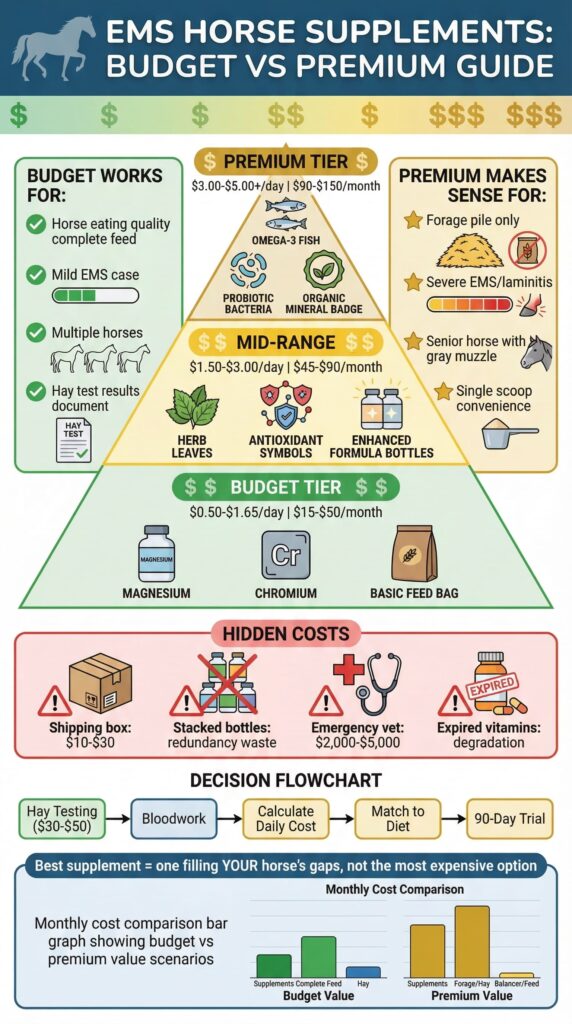
The daily cost breakdown typically falls into three tiers. Budget-friendly options focus on core minerals like magnesium and chromium, usually running $0.50 to $1.50 per day for a 1,000-pound horse. Mid-range products add trace minerals, antioxidants, and sometimes herbal ingredients, costing $1.50 to $3.00 daily. Premium comprehensive formulas pack in omega-3s, organic minerals, probiotics, and specialized ingredients, reaching $3.00 to $5.00 or more per day.[1] **Here’s the catch most horse owners miss: the cheapest option isn’t always the most economical if it doesn’t meet your horse’s actual requirements.** You might save $50 on a basic supplement only to spend another $40 adding separate vitamin E, zinc, and copper to fill the gaps. Suddenly your “budget” approach costs more than a comprehensive formula would have.
To understand which vitamins, minerals, and herbs target insulin resistance, read our comprehensive insulin-resistant horses supplements guide.
Budget-Friendly EMS Supplement Options
Let’s start with the wallet-friendly choices that deliver targeted metabolic support without draining your savings account. These products focus on the core ingredients research suggests may help insulin-resistant horses: magnesium and chromium.
Simple Magnesium-Chromium Blends
Products like UltraCruz Equine Metabolic Support, MVP Anti-Carb, and similar generic magnesium-chromium pellets represent the most economical entry point for EMS supplementation. These straightforward formulas typically provide 5,000–10,000 mg of magnesium (from various sources like magnesium oxide or citrate) plus 3–5 mg of chromium yeast per daily serving.[2][3]
The cost advantage is significant. Most of these supplements run between $30 and $50 for a month’s supply, working out to $1.00–$1.65 per day. For owners managing multiple metabolic horses or operating on tight budgets, this difference adds up to hundreds of dollars annually compared to premium options.
Who benefits most from budget magnesium-chromium supplements? Horses already on a quality ration balancer or complete feed that addresses vitamin and mineral needs. If your horse is getting adequate copper, zinc, selenium, and vitamin E from other sources, adding just magnesium and chromium for specific metabolic support makes financial sense.[4]
For detailed reviews of specific products, see our guide to the best supplements for insulin-resistant horses.
Buy UltraCruz Equine Metabolic Support
As an Amazon Associate I earn from qualifying purchases. Please be assured this does not cost you any extra.
Budget-Friendly Ration Balancers
Standard ration balancers not specifically marketed for EMS can be surprisingly effective budget options. Products designed for easy keepers or general forage balancing often contain adequate levels of trace minerals and vitamins while keeping NSC content low enough for metabolic horses.
These typically cost $0.75–$1.25 per day and provide baseline nutrition. While they may not have the elevated magnesium and chromium levels of specialized EMS formulas, they prevent the vitamin and mineral deficiencies that develop when horses are on restricted, forage-only diets. For horses with mild metabolic concerns or those in early management stages, a quality balancer plus careful diet control may be sufficient.[5]
The “DIY Approach” Cost Analysis
Some budget-conscious owners build their own supplement program by purchasing individual ingredients: plain magnesium oxide, chromium yeast, generic vitamin E, and a basic trace mineral mix. Done correctly, this approach can cost $0.60–$1.00 per day.
The savings come with trade-offs. You need to accurately measure and mix ingredients daily, source quality individual components, and understand proper dosing for each nutrient. One mistake—like overfeeding magnesium leading to diarrhea or imbalanced copper-to-zinc ratios—can cost more in vet bills than you saved on supplements. For horse owners confident in equine nutrition or working with a nutritionist, this route offers maximum control and minimum cost. For others, the complexity may not be worth the savings.[6]
Mid-Range EMS Supplement Options
Stepping into the $1.50–$3.00 per day range opens access to supplements specifically formulated for metabolic horses with more comprehensive ingredient lists. These products typically combine magnesium and chromium with additional supportive nutrients.
Enhanced Metabolic Formulas
Products like Mad Barn’s MagneChrome represent this mid-tier category. These supplements provide core metabolic support (magnesium and chromium) plus targeted additions like turmeric for antioxidant benefits, CoQ10 for cellular energy support, and sometimes adaptogenic herbs. Daily cost typically runs $1.80–$2.50 for a 1,000-pound horse.[7]
The value proposition here balances targeted support with reasonable pricing. You’re not paying for comprehensive vitamin-mineral coverage, but you are getting ingredients specifically chosen to address metabolic dysfunction, inflammation, and oxidative stress associated with insulin resistance. These work well when paired with a separate ration balancer to cover basic nutritional needs.[8]
This tier also includes some brand-name metabolic support supplements like Platinum Metabolic Support (standalone, not the comprehensive wellness formulas). At around $2.00–$2.50 per day, these provide magnesium citrate and chromium yeast in a convenient pelleted form with a reputable company backing. The peace of mind and quality assurance may justify the price for some owners, even if the ingredient list is relatively simple.[9]
| Supplement Category | Daily Cost Range | Primary Ingredients | Best For |
|---|---|---|---|
| Basic Magnesium-Chromium | $0.50–$1.65 | Mag, Cr only | Horses on complete feeds or balancers |
| Standard Ration Balancer | $0.75–$1.25 | Vitamins, minerals, amino acids | Forage-based diets, mild EMS |
| Enhanced Metabolic Formula | $1.80–$2.50 | Mag, Cr, herbs, antioxidants | Targeted metabolic support + balancer |
| Premium Comprehensive | $3.00–$5.00+ | Complete nutrition, omega-3s, probiotics | Horses needing all-in-one solution |
Premium EMS Supplement Options
At the top of the price spectrum sit comprehensive wellness formulas specifically designed for metabolic horses. These products aim to provide complete nutritional support in a single bucket, combining metabolic-specific ingredients with broad-spectrum vitamins, minerals, omega-3 fatty acids, antioxidants, and often digestive support.
Comprehensive Metabolic Formulas
Mad Barn’s AminoTrace+ exemplifies this category. Formulated specifically to ECIR (Equine Cushing’s and Insulin Resistance) group specifications, it provides 100% organic trace minerals, elevated magnesium and chromium, essential amino acids, natural vitamin E, and a proprietary blend of yeast, prebiotics, and antioxidants. The daily cost for a 1,000-pound horse runs approximately $3.00–$3.50 depending on purchase size and retailer.[10][11]
The value argument for premium supplements rests on comprehensiveness and convenience. Instead of juggling a balancer, separate metabolic support, vitamin E, omega-3 source, and maybe a probiotic—each requiring measurement and mixing—you feed one product. For busy horse owners or boarding situations where barn staff handle feeding, this simplicity has real value beyond the ingredient list.
Premium comprehensive formulas also typically use higher-quality ingredient forms. Organic trace minerals like zinc proteinate and copper proteinate show better absorption than inorganic forms. Natural vitamin E (d-alpha tocopherol) is more bioavailable than synthetic versions. These quality differences don’t always show up in guaranteed analysis percentages but may impact how effectively your horse utilizes the nutrients.
Premium Wellness Formulas with Metabolic Add-Ons
Some companies offer comprehensive wellness formulas (Platinum Performance Equine, for example) designed for any horse, with separate metabolic support products that can be added. This modular approach lets you start with a base wellness formula ($3.50–$4.50/day) and add targeted metabolic support ($1.50–$2.50/day) if needed, bringing total cost to $5.00–$7.00 daily.[12]
The premium here lies in the comprehensive base formula providing omega-3s from flax and fish oil, extensive vitamin and mineral coverage, antioxidants, and often joint support ingredients. You’re essentially feeding a complete horse wellness program that happens to include metabolic support rather than a metabolic-specific supplement.[13]
For performance horses, senior horses with multiple health concerns, or horses where owners want maximum nutritional support, these premium options may deliver value despite the price tag. For a horse whose only issue is insulin resistance and whose owner can manage a forage-based diet well, the extra cost may not provide proportional benefit.
When Budget Options Work Best
Budget-friendly EMS supplements shine in specific scenarios where targeted, simple interventions meet the horse’s actual needs. Understanding when less expensive options are genuinely sufficient—not just “good enough”—helps you spend wisely.
Horses already receiving a quality ration balancer or low-NSC complete feed benefit most from basic magnesium-chromium supplements. If your feeding program already provides adequate copper (10–20 mg/kg of diet), zinc (40–50 mg/kg), selenium (0.1–0.3 mg/kg), and vitamin E (at least 1–2 IU/kg bodyweight), adding an expensive comprehensive supplement creates redundancy and excess.[14]
Early-stage EMS cases with mild insulin dysregulation often respond well to dietary management plus simple mineral supplementation. When a horse shows minimal cresty neck development, maintains healthy weight relatively easily on forage, and has only slightly elevated insulin values, aggressive supplementation may not be necessary. Starting with budget options lets you assess response before investing in premium products.[15]
Multiple horse households face unique cost challenges. When managing two, three, or more metabolic horses, the difference between $1.00 and $4.00 per horse per day translates to $900–$3,600 annually per horse. For small farms or rescue organizations, budget-friendly supplements that address core metabolic needs while maintaining financial sustainability make responsible sense.[16] **Budget supplements work best when you’ve tested your hay and know exactly what nutrients your horse is—or isn’t—getting from forage.** Without this information, you’re guessing at whether a simple supplement is sufficient or leaving dangerous nutritional gaps.
When Premium Options Make Sense
Despite higher costs, premium comprehensive supplements prove economically sensible in several situations where their benefits outweigh price differences.
Horses on restricted, forage-only diets without any commercial feed face the highest risk of vitamin and mineral deficiencies. When you’re feeding nothing but tested low-NSC hay to achieve weight loss or manage insulin resistance, a comprehensive supplement that provides complete micronutrition becomes essential rather than optional. The alternative—buying separate vitamin E, trace mineral mix, amino acid source, and metabolic support—often costs nearly as much while requiring more effort.[17]
Chronic laminitis cases or horses with severe metabolic dysfunction may benefit from the enhanced antioxidant support, organic mineral forms, and specialized ingredients in premium formulas. When hoof growth, recovery, and metabolic stability are critical, the difference between adequate and optimal nutrition could impact long-term soundness. In these cases, the higher supplement cost pales compared to veterinary expenses for repeated laminitis episodes.[18] Learn more about targeted support in our review of 10 laminitis relief supplements for equine hoof health.
Senior horses with both metabolic concerns and age-related challenges (dental issues, poor absorption, muscle loss) often need the comprehensive support premium supplements provide. When you’re managing PPID, EMS, and the general nutritional demands of aging, an all-in-one solution that addresses multiple systems simultaneously simplifies management and may improve overall results.[19]
Convenience carries real value in some situations. Boarding barns that charge for supplement administration, owners with multiple time-consuming jobs, or horses on complex medication schedules may find premium one-scoop solutions worth the price for sheer simplicity and compliance assurance. A $4.00 daily supplement your horse actually gets every day beats a $1.50 supplement that gets forgotten three days per week.
Hidden Costs to Consider
The sticker price on a supplement bag rarely tells the complete financial story. Several hidden costs can shift the budget equation significantly.
Shipping and Bulk Purchase Savings
Supplement shipping costs add $10–$30 to each order, sometimes more for heavy bags. A budget supplement that requires monthly ordering plus shipping may cost more than a premium product you can buy in bulk with free shipping. Some companies offer subscription services with discounts—5–10% savings that accumulate over time.
Buying in larger sizes always reduces per-serving cost, but only if you can use the product before it expires. Vitamins, especially E and A, degrade over time. That 25-pound bucket saving you 15% means nothing if the last third oxidizes before you use it. For single horses, smaller bags may actually be more economical despite higher per-pound prices.[20]
Supplement Stacking
Many horses end up on supplement stacks: a metabolic formula, plus separate vitamin E, plus magnesium, plus a joint supplement, plus a digestive aid. Each product seems reasonably priced individually, but the combined cost often exceeds a comprehensive premium formula that addresses multiple concerns.
Worse, stacking creates overlap risks. Feeding multiple products with magnesium, for instance, can push intake to levels causing diarrhea or, in some competition disciplines, positive drug tests. Paying for duplicate nutrients while risking imbalances isn’t economical no matter how affordable each product seems.
Opportunity Costs of Ineffective Management
The largest hidden cost is ineffective EMS management leading to laminitis. A single acute laminitis episode can easily cost $2,000–$5,000 in emergency vet care, radiographs, shoes or boots, medications, and stall rest management. Chronic cases requiring ongoing farrier and veterinary support can run $500–$1,000 monthly.
If saving $60 per month on supplements means compromising nutritional support that helps prevent laminitis, you’re not actually saving money—you’re deferring costs. The “best value” supplement is the one that, combined with appropriate diet and management, keeps your horse sound and reduces veterinary intervention needs.[21]
Making Your Budget-Based Decision
Choosing the right EMS supplement at the right price point requires honest assessment of your situation, your horse’s specific needs, and your management capabilities.
Start with hay testing ($30–$50 per sample). This single investment tells you whether your forage is appropriate for metabolic horses and identifies specific mineral imbalances. If your hay is high in iron (common) and low in copper and zinc (also common), you know you need a supplement addressing these gaps—whether budget or premium.[22]
Request bloodwork including insulin, glucose, and ideally ACTH if PPID is suspected. Knowing your horse’s actual metabolic status—rather than assuming based on body condition—prevents both over-supplementing mild cases and under-supporting severe ones. Insulin levels help you gauge whether you need comprehensive metabolic support or simple mineral supplementation.
Evaluate your current feeding program honestly. Are you feeding a quality low-NSC ration balancer? A complete feed? Just hay? The more complete your base diet, the less comprehensive your metabolic supplement needs to be. Conversely, forage-only diets demand more complete supplementation.
Consider your management style and compliance capability. If you’re at the barn twice daily and enjoy measuring and mixing multiple products, a DIY approach might work. If you board or have a busy schedule, convenience has monetary value. Choose the most comprehensive supplement you can afford if compliance is questionable—the best supplement is the one that actually gets fed.
Calculate true cost per day, not per bag. Divide the price by actual servings based on your horse’s weight. Factor in shipping, bulk discounts, and subscription savings. Compare what you’re actually spending over 30, 60, or 90 days rather than initial purchase prices.
Monitor and adjust based on results. After 90 days on a budget or premium supplement, reassess body condition, hoof quality, coat condition, and behavior. If needed, recheck insulin levels. If you’re seeing positive results on a budget supplement, great—keep your money. If results are lackluster despite proper diet and exercise, moving to a more comprehensive option might be worth the investment.[23]
| Your Situation | Recommended Approach | Expected Daily Cost |
|---|---|---|
| On quality ration balancer or complete feed | Basic magnesium-chromium only | $0.50–$1.65 |
| Forage-only diet, mild EMS | Standard ration balancer | $0.75–$1.50 |
| Forage-only, moderate EMS | Mid-range metabolic formula OR balancer + mag/cr | $1.50–$3.00 |
| Forage-only, severe EMS or chronic laminitis | Premium comprehensive formula | $3.00–$5.00 |
| Multiple metabolic horses | Budget options with strategic supplementation | $1.00–$2.00 per horse |
| Senior with EMS + other concerns | Premium comprehensive formula | $3.50–$5.00 |
Real-World Budget Success Stories
Understanding theoretical cost differences matters, but seeing how horse owners successfully manage EMS on various budgets provides practical perspective. While individual results vary based on horse needs, forage quality, and management intensity, these scenarios illustrate effective strategies across the price spectrum.
One owner managing three easy-keeper ponies with mild insulin resistance invested $50 in hay testing, discovered her local hay was low in copper and zinc but otherwise appropriate, and chose a basic ration balancer ($0.90/day per pony) plus stand-alone magnesium oxide ($0.35/day per pony). Total cost: $1.25 per pony per day or $3.75 daily for all three. After six months, all three ponies maintained healthy weight on forage-only diets with restricted grazing, showed improved coat quality, and had normal insulin levels on follow-up testing.
A different owner with a single Warmblood gelding with confirmed EMS and previous laminitis history chose a premium comprehensive formula at $3.50 per day. The horse was on a forage-only diet with no ration balancer. After four months, hoof growth improved, the cresty neck reduced, and repeat glucose tolerance testing showed significant improvement. The owner noted that while expensive, the convenience of one product and confidence in complete nutrition reduced stress and boarding barn administration challenges.
These real examples highlight that success isn’t about spending the most or least—it’s about matching supplement choice to specific circumstances while maintaining consistency in the overall management program.[24]
Conclusion
Managing EMS on a budget doesn’t mean compromising your horse’s health—it means making informed choices about where your supplement dollars go. The difference between a $30 monthly basic magnesium-chromium supplement and a $150 monthly premium comprehensive formula may or may not be justified depending on your horse’s diet, metabolic severity, and existing nutritional support.
Budget options work beautifully for horses already receiving adequate vitamins and minerals from ration balancers or complete feeds, mild EMS cases with good dietary control, and multiple-horse situations where cost sustainability matters. Premium comprehensive supplements shine when managing forage-only diets, severe metabolic dysfunction, senior horses with multiple concerns, or situations where convenience dramatically improves compliance.
The smartest spending strategy starts with hay testing to identify what your horse actually needs, then selects the supplement—budget, mid-range, or premium—that fills those specific gaps. Combine this targeted approach with disciplined weight management, appropriate exercise, and veterinary monitoring, and you’ve built an economically sustainable EMS management program that works for both your horse and your budget.
EMS Horse Supplements Comparison Budget vs Premium FAQs
How much should I budget monthly for EMS horse supplements?
Monthly supplement costs for EMS horses typically range from $15 to $150 depending on product type and horse needs. Basic magnesium-chromium supplements run $15–$50 per month, mid-range metabolic formulas cost $45–$90 monthly, and premium comprehensive formulas range from $90–$150 or more. The appropriate budget depends on your horse’s dietary foundation, metabolic severity, and whether they’re on forage-only feeding or receiving commercial feeds that already provide some nutritional support.
Are expensive EMS supplements worth the extra cost compared to budget options?
Expensive supplements are worth the cost when they provide nutrients your horse genuinely needs that budget options don’t deliver. Premium comprehensive formulas make sense for horses on forage-only diets requiring complete vitamin-mineral coverage, severe EMS cases benefiting from enhanced antioxidant support, or situations where one-scoop convenience improves feeding compliance. However, for horses already on quality ration balancers who only need targeted magnesium and chromium support, budget-friendly options deliver equal metabolic benefit at a fraction of the cost.
Can I save money by making my own EMS supplement mix at home?
Creating a DIY supplement mix using individual ingredients like magnesium oxide, chromium yeast, and separate minerals can cost $0.60–$1.00 per day, potentially saving money. However, this approach requires accurate measuring equipment, understanding proper dosing for each nutrient, and careful attention to mineral ratios (especially copper-to-zinc balance). Mistakes can cause imbalances or deficiencies costing more in vet bills than you saved on supplements. Work with an equine nutritionist if pursuing this route, and factor in the time investment of daily measuring and mixing when calculating true cost savings.
Should I choose pellets, powder, or liquid supplements for my EMS horse?
Form selection affects both cost and convenience rather than effectiveness. Powders are often the most budget-friendly ($0.50–$2.50/day) but can be messier and may be refused by picky eaters. Pellets ($1.00–$3.50/day) mix easily with feed and are generally well-accepted but may cost slightly more per serving. Liquids ($1.50–$4.00/day) offer easy administration and consistent dosing but typically have the highest per-serving cost and can be less economical for long-term daily use. Choose based on your horse’s palatability preferences, your feeding situation, and whether convenience justifies any price difference.
How long should I try a budget supplement before upgrading to a premium option?
Give any EMS supplement a fair 90-day trial before switching or upgrading, assuming you’re also maintaining appropriate diet and exercise. Most metabolic improvements in body condition, hoof quality, and coat appearance take 8–12 weeks to become visible. After three months, evaluate whether your horse shows positive changes in body condition scoring, cresty neck reduction, energy levels, and hoof growth. Consider rechecking insulin levels if they were previously elevated. If results are unsatisfactory despite proper management, consultation with your vet and potentially upgrading to a more comprehensive supplement may be warranted.
EMS Horse Supplements Budget Comparison Citations
- Equine “Metabolic Support” Supplements: A Comparison
- Anti-Carb – Magnesium Chromium Supplement for Horses
- UltraCruz Equine Metabolic Support Supplement for Horses
- How to Feed a Horse with Equine Metabolic Syndrome
- Treatment & Management of Equine Metabolic Syndrome (EMS)
- Supplements for Horses with Equine Metabolic Syndrome Researched
- MagneChrome Supplement for Metabolic Horses
- Shop Metabolic Supplements for Horses
- Platinum Metabolic Support
- AminoTrace+ Vitamin & Mineral Supplement for Horses
- AminoTrace+ Vitamin and Mineral Supplement (Mad Barn) – Equine Nutrition Analysis
- Equine Metabolic Support | Magnesium Supplements For Horses
- Platinum Performance
- Equine Metabolic Supplements to Support a Healthy Metabolism
- Recommended nutritional supplement for horses challenged by equine metabolic syndrome and PPID
- Best Supplements for Insulin Resistant Horses: Top Picks Reviews
- Insulin Resistant Horses Supplements Guide: Vitamins, Minerals and Herbs
- 10 Laminitis Relief Supplements for Equine Hoof Health
- PPID Senior Horse Metabolic Issues Dietary Management Preventative Care
- Platinum Performance Review: Horse Supplements Worth the Price?
- Best Anti-Inflammation Supplements for Horses (A Research Scientist’s Guide)
- Best Low-Sugar Feeds for Weight Management in EMS Horses
- Magnesium Supplements for Muscle in Overweight Horses
- Effective EMS Horse Health Supplements in Powder Form




Leave a Reply