
Key Takeaways
- Pure MSM powder (99.9%) delivers the active ingredient without fillers, offering maximum flexibility in dosing for laminitic horses
- Pelleted MSM formulations contain inactive ingredients like alfalfa meal and flax seed that add volume but reduce MSM concentration per serving
- Both forms have the same bioavailability when the MSM is properly manufactured through distillation processes
- For laminitic horses, 10-20 grams of pure MSM daily supports hoof wall integrity by providing sulfur for keratin synthesis
- MSM is considered safe for horses with EMS and insulin resistance, with no known toxicity at recommended doses
Article Summary
MSM (methylsulfonylmethane) supports hoof health in laminitic horses by providing bioavailable sulfur for keratin and collagen formation in the hoof wall. Pure MSM powder offers 99.9% concentration without fillers, while pelleted forms typically contain 27-30% MSM mixed with carrier ingredients. Both deliver the same therapeutic benefits when properly dosed, with pure forms offering more precise control for horses with metabolic conditions.
Understanding MSM’s Role in Hoof Health
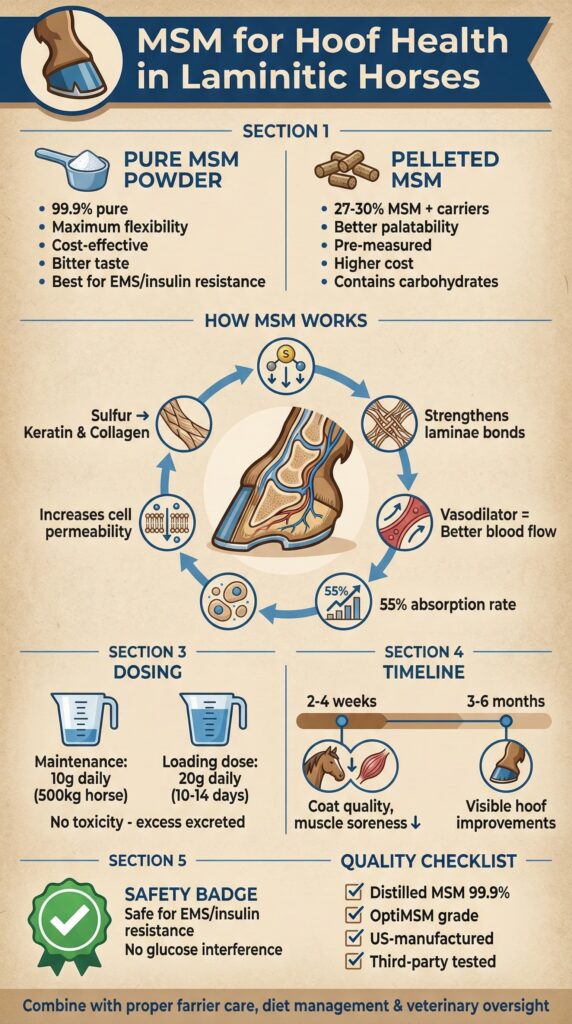
Methylsulfonylmethane provides your laminitic horse with a highly bioavailable source of organic sulfur that directly supports hoof wall structure. Sulfur from MSM helps form disulfide bonds in the hoof laminae, which are critical for securing the hoof wall to the internal sensitive structures.[1]
Your horse’s hooves grow slowly, typically taking 3 to 6 months to show visible improvement in the new hoof wall growing down from the coronary band.[2] This means patience and consistent supplementation are essential when using MSM for hoof health in laminitic horses.
MSM works by donating sulfur required for the synthesis of keratin, the primary structural protein in the hoof wall, and collagen, which forms the connective tissues inside the hoof.[1] For horses recovering from laminitis, this structural support can help produce a harder, less brittle hoof capsule that is better at resisting moisture damage and cracking.[1]
How MSM Supports Hoof Circulation
Beyond structural support, MSM can act as a mild vasodilator, helping to relax blood vessels and improve the delivery of nutrient-rich blood to the small capillaries within the hoof.[1] This improved circulation is particularly valuable for laminitic horses, where compromised blood flow to the hoof can slow healing and hoof growth.
Research shows that MSM has the highest absorption rate (55%) of all key equine joint ingredients, making it available for use in tissues throughout the horse’s body, including the hooves.[3] This high bioavailability means that the sulfur from MSM supplements reaches your horse’s hoof tissues efficiently.
MSM and Metabolic Horses
For horses with insulin resistance or equine metabolic syndrome (EMS), MSM offers additional benefits beyond hoof health. Sulfur assists by making cell walls more permeable for oxygen and nutrients to be readily absorbed while pushing toxins out.[4] This cellular support can help horses with metabolic conditions better utilize nutrients and maintain healthier tissue function throughout their bodies, including in their hooves.
Pure MSM Powder: The Concentrated Option
Pure MSM powder delivers 99.9% methylsulfonylmethane with no fillers or inactive ingredients. This form is manufactured through a distillation process that removes heavy metals and contaminants, leaving only pure MSM crystals.[5]
Manufacturing Quality Matters
The highest-quality pure MSM, such as OptiMSM produced by Bergstrom Nutrition in the United States, undergoes quadruple distillation to achieve pharmaceutical-grade purity.[5] This distillation method heats MSM to its boiling point (238°C), and the vapor is collected, cooled, and recrystallized into pure MSM crystals.[6]
The distillation process removes volatile organic compounds with lower boiling points and leaves behind heavy metals with higher boiling points, resulting in a final product that is biologically identical to MSM found in nature.[6]
Lower-quality MSM from some international manufacturers may use a crystallization process instead of distillation, which can trap unwanted contaminants and chemicals from the manufacturing process.[7] When selecting pure MSM for your laminitic horse, look for products that specify distillation purification and US manufacturing standards.
Dosing Flexibility with Pure MSM
Pure MSM powder gives you precise control over dosing, which is especially important for laminitic horses who may need adjusted amounts during different phases of recovery. A typical maintenance dose for a 500 kg horse is 10 grams per day, with loading doses of 20 grams daily for the first 10-14 days to quickly elevate sulfur levels.[1]
For horses with acute laminitis or founder, you can temporarily double the serving size to 20 grams per day without safety concerns, as MSM has no known toxicity and excess is rapidly excreted via urine.[8] Pure powder makes these dosage adjustments simple and cost-effective.
Palatability Considerations
One challenge with pure MSM powder is that it can have a slightly bitter taste at higher concentrations. However, most horses readily eat MSM when it’s top-dressed on their feed.[9] You can dissolve MSM powder in water up to a concentration of 4 grams per liter without the horse tasting it, though higher concentrations may produce a bitter taste.[6]
If your horse is sensitive to the taste, mix the MSM thoroughly with their feed, or consider adding a small amount of apple sauce or molasses-free feed topper to improve palatability. For EMS horses, avoid using sugary additives and instead mix with low-NSC feed pellets or soaked hay.
Pelleted MSM: Convenience with Compromises
Pelleted MSM supplements offer pre-measured convenience and often improved palatability compared to pure powder. The pelleting process incorporates MSM with carrier ingredients to create a stable, easy-to-feed supplement that many horses accept readily.
What’s in Pelleted MSM
Typical pelleted MSM formulations contain approximately 27-30% MSM by weight, with the remainder consisting of inactive ingredients such as dehydrated alfalfa meal, milled flax seed, lignin sulfonate, rice bran, soybean oil, and calcium propionate as a preservative.[10]
For example, a common pelleted MSM product may provide 21,000 mg of MSM per 76-gram serving (two scoops), whereas pure MSM delivers the same 21,000 mg in just 21 grams (two scoops).[10] This means you’re feeding about 3.6 times more material by volume to achieve the same MSM dose.
Benefits of Pelleted Forms
The main advantage of pelleted MSM is palatability. Manufacturers can add flavorings during the extrusion process, making pellets more enticing for picky eaters.[11] The carrier ingredients also provide some nutritional value – flax seed contributes omega-3 fatty acids, and alfalfa meal adds protein and minerals.
Pellets are also less messy than powder and won’t blow away in windy conditions or create dust during feeding. For owners managing multiple horses, pre-measured pellets can simplify feeding routines and reduce dosing errors.
Potential Drawbacks for Laminitic Horses
The carrier ingredients in pelleted MSM add carbohydrates that may concern owners of metabolic horses. While the total NSC content in a typical pelleted MSM serving remains relatively low (usually under 10 grams), horses with severe insulin dysregulation should have every dietary component carefully monitored.
The pelleting process itself involves pressure and sometimes heat, which isn’t ideal for all ingredients.[11] However, MSM is stable under normal pelleting conditions, so the active ingredient maintains its efficacy. Some manufacturers monitor pelleting equipment temperatures to ensure they remain within acceptable ranges that preserve ingredient quality.[11]
Cost-wise, pelleted MSM typically costs more per gram of active MSM compared to pure powder, since you’re paying for both the MSM and the carrier ingredients. For budget-conscious owners feeding multiple horses long-term, this price difference can add up significantly.
Bioavailability: Do Form Differences Matter?
When comparing pure and pelleted MSM, the critical question is whether one form is absorbed better than the other. Research shows that MSM has the highest absorption rate (55%) of all key equine joint ingredients, and this bioavailability applies regardless of whether the MSM is in pure powder or pelleted form.[3]
Absorption Factors That Actually Matter
The bioavailability of MSM depends primarily on the quality of the MSM itself, not the delivery form. High-purity distilled MSM will be absorbed efficiently whether it’s fed as pure powder mixed with feed or incorporated into pellets.[5]
What does affect absorption is the manufacturing process used to create the MSM. Distilled MSM is biologically identical to MSM found in nature and is readily utilized by your horse’s body.[6] Lower-quality crystallized MSM may contain impurities that reduce effective absorption.
Once in your horse’s digestive system, MSM splits into methionine and cysteine, two important sulfur-containing amino acids that your horse uses for protein synthesis and tissue building.[12] This metabolic pathway works the same way regardless of whether the MSM started as pure powder or a pellet.
Timing and Consistency
For both pure and pelleted MSM, consistency in daily supplementation matters more than form. MSM has a short half-life in the body, and excess is rapidly excreted in urine and feces.[9] This means your horse needs regular daily doses to maintain beneficial sulfur levels in hoof tissues.
You typically won’t see results from MSM supplementation for at least 3-6 months, as this is how long it takes for new hoof wall to grow down from the coronary band.[1] Some horses show improvements in coat quality and movement comfort within a few weeks, but hoof changes require patience regardless of which MSM form you choose.
Dosing Guidelines for Laminitic Horses
Proper dosing of MSM depends on your horse’s weight, the severity of their hoof condition, and whether they’re in an acute or maintenance phase of treatment.
Standard Maintenance Dosing
The most common recommendation is 2 grams of MSM per 100 kg (220 lbs) of body weight daily.[13] For a typical 500 kg (1,100 lb) horse, this translates to 10 grams per day. This maintenance dose provides sufficient sulfur to support normal hoof growth and keratin production.
Many supplement manufacturers recommend 10,500 mg (approximately 10 grams) twice daily for an average 1,000 lb horse, totaling 21 grams per day.[14] This slightly higher dose is often used for performance horses or those with ongoing joint issues in addition to hoof concerns.
Loading Doses for Acute Laminitis
When dealing with acute laminitis or founder, a loading dose protocol can help rapidly increase sulfur availability to support healing. Start with 20 grams daily for the first 10-14 days, then reduce to a maintenance dose of 7-10 grams daily.[1]
For severe cases, you can temporarily use up to 20 grams daily for extended periods.[4] Research on standardbred horses showed that 20 grams per day produced faster and more dramatic improvements than 10 grams per day, with horses experiencing less inflammation, reduced muscle enzyme leakage, and improved performance.[15]
Adjusting Doses Between Forms
When switching between pure and pelleted MSM, calculate based on actual MSM content, not serving size. If your horse needs 10 grams of MSM daily:
Pure MSM: Feed 10 grams of powder (typically about one level tablespoon)
Pelleted MSM: Check the label for MSM content per serving. If the pellets provide 21,000 mg (21 grams) MSM in 76 grams of pellets, you’d feed approximately 36 grams of pellets to achieve 10 grams of MSM.
Always verify the MSM concentration on your specific product label, as formulations vary between manufacturers.
| Horse Weight | Maintenance Dose (MSM) | Loading Dose (MSM) | Pure Powder Amount | Pelleted Amount* (27% MSM) |
|---|---|---|---|---|
| 400 kg (880 lbs) | 8 grams | 16 grams | 8 grams powder | 30 grams pellets |
| 500 kg (1,100 lbs) | 10 grams | 20 grams | 10 grams powder | 37 grams pellets |
| 600 kg (1,320 lbs) | 12 grams | 24 grams | 12 grams powder | 44 grams pellets |
*Approximate amounts based on 27% MSM concentration; always check your specific product label
Safety for EMS and Insulin-Resistant Horses
One of the most important questions for owners of laminitic horses is whether MSM is safe for horses with equine metabolic syndrome or insulin resistance. The good news is that MSM is considered one of the safest equine supplements, with no known toxicity.
MSM Safety Profile
MSM is regarded as one of the least toxic substances in biology, with no known side effects documented in any species to date.[3] It has an excellent track record of safety in horses, and there are no reported cases of MSM toxicity even at high doses.[9]
Because excess MSM is rapidly excreted via urine and feces, there’s no risk of harmful accumulation in your horse’s body.[9] This makes MSM particularly appropriate for long-term use in horses with chronic conditions like laminitis.
Considerations for Metabolic Horses
For horses with insulin dysregulation, MSM may actually provide benefits at the cellular level. With insulin resistance, cell walls can become thick, dehydrated, and hardened, interfering with nutrient and oxygen exchange.[4] Sulfur from MSM helps make cell walls more permeable, supporting the natural process of detoxification and nutrient absorption.[4]
This cellular support doesn’t interfere with insulin function or glucose metabolism. MSM works by supporting structural proteins and antioxidant systems, not by altering hormonal pathways.[12] Unlike medications such as metformin that directly affect glucose and insulin levels, MSM supports your horse’s cells’ ability to function normally.
Important Medical Cautions
While MSM is generally safe, there are a few situations requiring veterinary supervision:
Clotting disorders: Horses with known clotting disorders or those taking medications to aid clotting should not receive MSM without close veterinary supervision.[12]
Diabetes mellitus: The small number of horses with actual diabetes mellitus (not just insulin resistance) should not take MSM.[12] However, this condition is extremely rare in horses compared to insulin dysregulation.
Pregnant mares: MSM has not been approved for use in pregnant mares or horses intended for breeding.[12] If you’re supplementing a mare who might be pregnant, consult your veterinarian.
For the vast majority of laminitic horses with EMS or insulin resistance, MSM supplementation is both safe and potentially beneficial. The key is choosing a high-quality product and following appropriate dosing guidelines.
Comparing Pelleted vs. Pure: Decision Framework
Choosing between pure and pelleted MSM depends on your specific situation, your horse’s preferences, and your management priorities. Here’s how to make the best choice for your laminitic horse.
| Factor | Pure MSM Powder | Pelleted MSM | Best Choice For |
|---|---|---|---|
| MSM Concentration | 99.9% pure | 27-30% MSM | Pure powder for maximum concentration |
| Dosing Precision | Exact control, easy adjustments | Pre-measured by scoop | Pure powder for precise dosing needs |
| Cost per gram MSM | Lower (buying pure ingredient) | Higher (includes carrier costs) | Pure powder for budget efficiency |
| Palatability | May be slightly bitter | Often flavored, more acceptable | Pellets for picky eaters |
| Feeding Convenience | Requires mixing, can be dusty | Easy to scoop, less messy | Pellets for multi-horse operations |
| EMS Horse Concerns | Zero added carbohydrates | Contains NSC from carriers | Pure powder for strict metabolic control |
| Storage | Requires sealed container | More stable in humidity | Pellets for humid climates |
| Bioavailability | 55% absorption (high) | 55% absorption (high) | Equal – choose based on other factors |
When to Choose Pure MSM Powder
Pure MSM powder is your best option when:
• Your horse has severe insulin dysregulation and you need to minimize all dietary carbohydrates
• You’re feeding multiple horses and want the most cost-effective option
• You need to make frequent dosage adjustments during acute laminitis recovery
• You want maximum control over exactly what your horse consumes
• Your horse readily accepts powdered supplements mixed with feed
When to Choose Pelleted MSM
Pelleted MSM makes sense when:
• Your horse refuses to eat powdered supplements but accepts pellets
• You prefer pre-measured convenience and simpler feeding routines
• The small amount of carrier ingredients won’t impact your horse’s metabolic condition
• You feed in windy conditions where powder would blow away
• You want the additional nutritional benefits from ingredients like flax seed
The Hybrid Approach
Some owners successfully use both forms – pure powder for their metabolically sensitive horses who need strict dietary control, and pelleted MSM for horses who are picky eaters or have less severe metabolic concerns. There’s no requirement to stick with only one form across your entire barn.
Combining MSM with Other Hoof Supplements
MSM works synergistically with other hoof-building nutrients, and many horses with chronic laminitis benefit from a comprehensive supplementation program rather than MSM alone.
Proven Synergistic Combinations
MSM + Biotin: Biotin at 15-20 mg per day supports keratin production through a different pathway than MSM.[16] Research shows that horses with poor hoof quality benefit from both sulfur (via MSM) and biotin supplementation, as they address different aspects of hoof wall integrity.
MSM + Methionine: Methionine is a sulfur-containing amino acid that supports hoof health when methionine intake is low. Supplementation of 5,000-10,000 mg per day of methionine alongside MSM can improve hoof wall integrity.[15] MSM helps spare methionine from being broken down for its sulfur content, allowing more methionine to be used for protein synthesis.[9]
MSM + Zinc and Copper: These minerals are essential for healthy hoof growth, and horses with low intakes are more likely to develop white line disease.[15] However, excess sulfur in the diet can theoretically interfere with copper absorption, so if you’re feeding multiple sulfur-rich supplements, ensure your horse’s copper and zinc levels are balanced.[1]
Caution with Multiple Sulfur Sources
If you’re feeding both MSM and methionine together, monitor your horse’s total sulfur intake. While both supplements are generally safe, providing very high levels of multiple sulfur sources could potentially create mineral imbalances, particularly with copper.[1]
Work with an equine nutritionist to ensure your horse’s complete diet – including hay, feed, and all supplements – provides balanced minerals alongside the sulfur from MSM.
What MSM Can’t Fix
While MSM supports hoof health from the inside, it can’t replace proper hoof care and trimming. Laminitic horses need skilled farrier work to address mechanical issues like underrun heels, flared walls, and incorrect angles. MSM provides the nutritional building blocks for healthy hoof growth, but your farrier shapes that growth into a functional hoof.
Similarly, MSM doesn’t address the underlying metabolic issues causing laminitis. Horses with EMS still need careful diet management, weight control, and exercise programs alongside any supplementation. Think of MSM as one tool in a comprehensive laminitis management program, not a standalone cure.
Timeframe for Results: Setting Realistic Expectations
One of the most common questions about MSM supplementation is “when will I see results?” Understanding the timeline helps you set realistic expectations and maintain consistency.
Short-Term Changes (2-4 Weeks)
Within the first few weeks of MSM supplementation, you might notice improvements in your horse’s coat quality and potentially reduced muscle soreness after exercise.[15] Trainers often report that horses on MSM have better hair coats and appear more comfortable during work.
Some horses show reduced inflammation and improved mobility within 2-4 weeks, particularly if they’re also receiving MSM for joint support.[17] However, these early changes don’t reflect hoof improvements yet – they’re signs that the MSM is being absorbed and utilized throughout your horse’s body.
Hoof Changes (3-6 Months)
Because hooves grow slowly (approximately 6-10 mm per month at the toe), visible improvements in hoof quality typically take 3-6 months of consistent supplementation.[1] This is how long it takes for new hoof wall to grow down from the coronary band where the growth occurs.
At around 3 months, you should start seeing a more distinct line between the old hoof wall (grown before MSM supplementation) and new hoof wall (grown with adequate sulfur support). The new growth often appears healthier, with better horn quality and less crumbling or chipping.
By 6 months, the new hoof wall should comprise a significant portion of the hoof capsule, and your farrier should notice improved hoof quality when trimming.
Factors That Affect Results
Several factors influence how quickly and dramatically your horse responds to MSM:
Severity of initial deficiency: Horses with significant sulfur deficiency show more dramatic improvements than those with borderline deficiency.
Quality of base diet: MSM works best when your horse’s overall nutrition is balanced. Horses eating poor-quality hay or mineral-deficient diets won’t see optimal results from MSM alone.
Concurrent conditions: Horses dealing with active laminitis, severe insulin dysregulation, or other health issues may take longer to show hoof improvements even with adequate MSM.
Individual variation: Some horses are simply faster responders than others due to genetic factors and metabolic differences.
Product Quality: What to Look for When Buying
Not all MSM supplements are created equal. The quality of your MSM product directly affects how well it supports your laminitic horse’s hoof health.
Purity Standards
Look for MSM products that specify 99.9% purity or higher.[5] The highest-quality MSM is produced through distillation rather than crystallization, resulting in a product that’s free from heavy metal contaminants.[6]
Products featuring OptiMSM or similar branded, distilled MSM have undergone rigorous quality testing and meet pharmaceutical-grade standards.[5] While these products may cost slightly more, the guaranteed purity and safety make them worth the investment for horses with serious health conditions like laminitis.
Manufacturing Location
MSM manufactured in the United States typically undergoes more stringent quality control and safety testing than products from some international sources.[7] US-manufactured MSM is produced according to Good Manufacturing Practices (GMP) and undergoes regular testing for contaminants.
Be cautious of very cheap MSM products, particularly those that don’t specify their manufacturing location or purification method. Lower-quality MSM from certain international manufacturers may use crystallization processes that can trap contaminants.[7]
Third-Party Testing
The best MSM products provide certificates of analysis showing they’ve been tested by independent laboratories for purity, heavy metals, and microbial contamination.[5] Look for manufacturers who are transparent about their testing procedures and willing to provide documentation.
Reading Pelleted Supplement Labels
When evaluating pelleted MSM, check the guaranteed analysis section to determine the actual MSM content per serving. Calculate the cost per gram of MSM, not per serving, to compare products fairly.
Review the inactive ingredients list. For horses with EMS, avoid pelleted supplements that include molasses or other high-sugar carriers. Look for formulations using low-NSC carriers like timothy pellets or beet pulp (without molasses) if such options are available.
Conclusion
Both pure MSM powder and pelleted MSM formulations effectively support hoof health in laminitic horses when you choose high-quality products and follow appropriate dosing guidelines. Pure powder offers maximum concentration, dosing flexibility, and cost efficiency, making it ideal for horses with strict dietary requirements or owners managing multiple animals. Pelleted MSM provides improved palatability and convenience for horses who refuse powdered supplements.
The most important factors for success aren’t which form you choose, but rather the purity of the MSM, consistency of supplementation, and integration with comprehensive laminitis management including proper farrier care, dietary control, and veterinary oversight. Expect to invest 3-6 months before seeing visible hoof improvements, as this timeframe reflects the natural rate of hoof growth from the coronary band.
For laminitic horses with EMS or insulin resistance, MSM is considered safe and may provide additional cellular benefits beyond hoof support. Work with your veterinarian and equine nutritionist to ensure MSM supplementation fits appropriately within your horse’s complete health plan, alongside other evidence-based therapies for managing laminitis and metabolic conditions.
MSM Hoof Health FAQs
Can I use MSM for horses with active laminitis?
Yes, MSM is safe for horses with active laminitis. You can use a loading dose of 20 grams daily during acute episodes to quickly elevate sulfur levels that support hoof healing. MSM reduces inflammation and improves circulation to the hoof, which can help during recovery. However, MSM should be part of a comprehensive laminitis treatment plan under veterinary supervision, not used as the sole therapy.
How long does MSM take to improve hoof quality in laminitic horses?
You’ll typically see visible improvements in hoof quality after 3-6 months of consistent MSM supplementation. Because hooves grow slowly from the coronary band, it takes this long for new, healthier hoof wall to grow down and replace the damaged tissue. Some horses show improvements in coat quality and comfort within 2-4 weeks, but hoof changes require patience.
Is pure MSM powder or pelleted MSM better for horses with EMS?
Pure MSM powder is generally better for horses with equine metabolic syndrome because it contains zero added carbohydrates. Pelleted MSM includes carrier ingredients like alfalfa meal and flax seed that add small amounts of NSC (non-structural carbohydrates). For horses with severe insulin dysregulation where every carbohydrate source must be controlled, pure powder gives you complete control over what your horse consumes.
Can MSM interfere with copper absorption in horses?
Excess sulfur in the diet can theoretically interfere with copper absorption, particularly if you’re feeding multiple sulfur-rich supplements like MSM and methionine together. To prevent this, ensure your horse’s diet provides adequate copper and zinc through a balanced vitamin/mineral supplement. Have your hay tested and work with an equine nutritionist to confirm all minerals are properly balanced when using MSM.
What’s the difference between OptiMSM and regular MSM powder?
OptiMSM is a branded, pharmaceutical-grade MSM manufactured through a proprietary four-stage distillation process that achieves 99.9% purity and removes heavy metal contaminants. Regular MSM powder may be produced through less rigorous crystallization methods that can leave impurities. While both forms contain methylsulfonylmethane, OptiMSM undergoes more extensive quality testing and is the only MSM with published peer-reviewed safety and efficacy research.
MSM Hoof Health Citations
- Mad Barn – 9 Science-Backed Benefits of MSM for Horses
- Jenquine – MSM – Methyl Sulfonyl Methane
- SmartPak Equine – MSM For Horses
- Yucc’ It Up! Equine Supplements – MSM
- Balchem – OptiMSM
- Kala Health – MSM Powder Quality from the EU and US
- The Holistic Horse – MSM Ultra Pure Powder for Horses
- EquiMed – Methylsulfonylmethane
- Mad Barn – MSM Supplement for Horses
- Santa Cruz Animal Health – UltraCruz Equine MSM Horse Supplement
- SmartPak – Form Factor: Powder, Pellet, Liquid, or Paste Supplements
- EquiMed – Methylsulfonylmethane (Metabolic Pathway Information)
- HolistaPet – MSM For Horses Benefits, Dosages, & Feeding Suggestions
- Platinum Performance – MSM for Horses
- Jenquine – MSM Research and Clinical Trials
- HoofRoom – Biotin Supplements Review for Laminitis Horses
- EAC Animal Care – How MSM Supplements Can Benefit Your Horse





Leave a Reply